
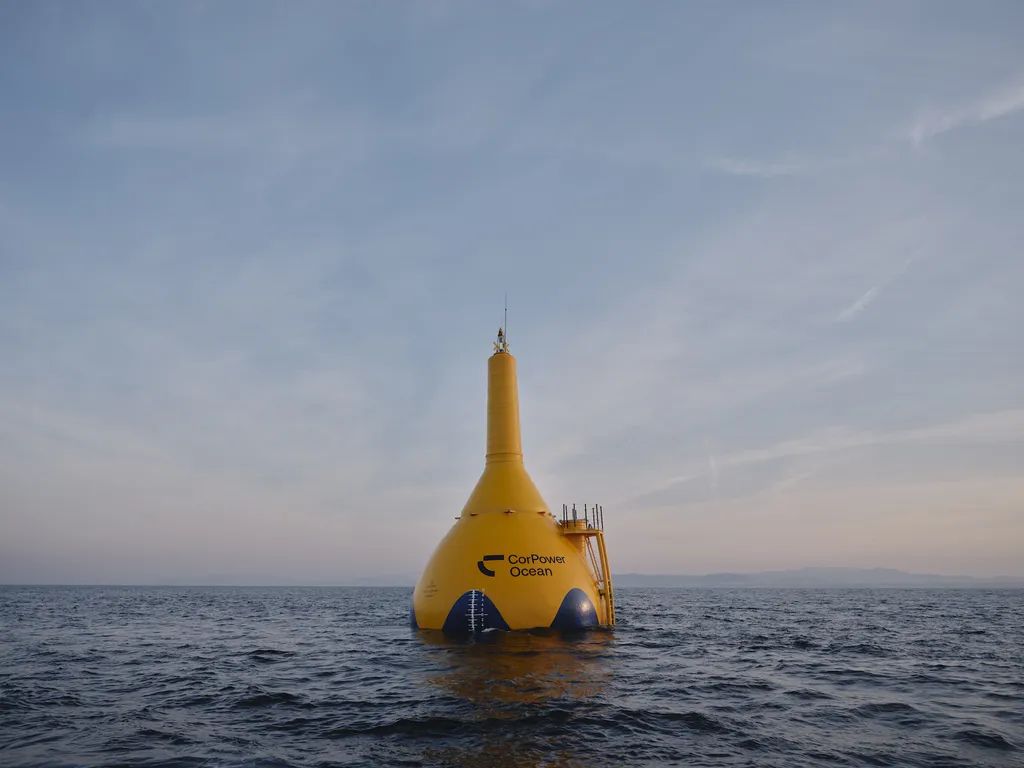
Researchers Tanu Singla, Jean-Baptiste Gorce, and Eric Falcon, affiliated with the University of Paris, have conducted a study on the effects of finite-system size on the dynamics of weakly nonlinear random gravity-capillary surface waves. Their findings, published in the journal Physical Review Fluids, offer insights that could have practical applications in the energy sector, particularly in wave energy conversion systems.
The researchers conducted experiments in rectangular tanks with varying aspect ratios. They perturbed the fluid surface locally and erratically using small, partially submerged magnets. These magnets, driven by an oscillating vertical electromagnetic field, generated a statistically homogeneous and isotropic random wave field. This setup allowed the team to investigate finite-size effects without the dominant influence of global forcing present in horizontally oscillated tanks.
The study revealed multiple branches in the wave-energy spectrum along the unconfined direction, corresponding to sloshing modes in the confined direction. The spectral properties of these modes could be tuned by varying either the wave steepness or the confinement. The researchers observed signatures of discrete wave turbulence in the confined direction and mesoscopic continuous wave turbulence in the unconfined direction. As the confinement was gradually relaxed, they demonstrated a smooth transition from discrete to continuous wave turbulence, consistent with the nonlinear-to-discreteness timescale ratio.
Using high-order correlation analysis, the team showed that finite-size effects alter wave dynamics by depleting two-dimensional three-wave resonant interactions along the confined direction. This finding could have implications for wave energy conversion systems, where understanding and predicting wave dynamics is crucial for optimizing energy capture and conversion efficiency.
In summary, the study provides valuable insights into the effects of finite-system size on wave dynamics, which could inform the design and operation of wave energy conversion systems. The researchers’ experimental setup and analytical methods offer a robust framework for further investigations in this area. The research was published in the journal Physical Review Fluids, volume 6, issue 8, August 2021.
This article is based on research available at arXiv.