
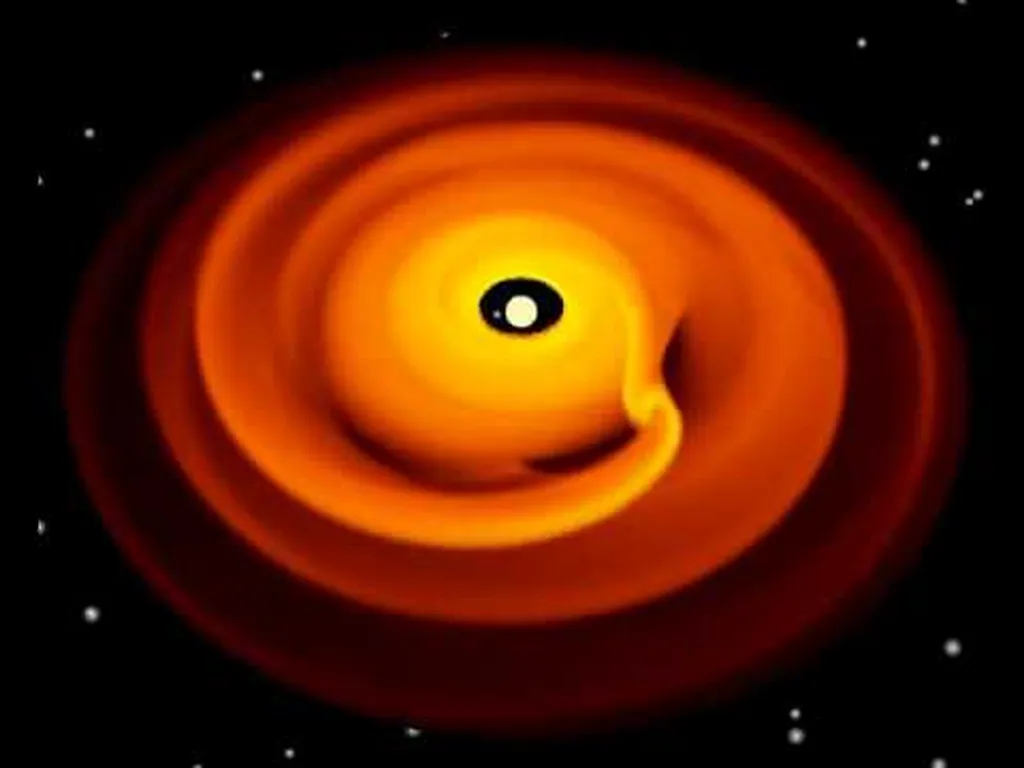
In the realm of astrophysics and planetary science, a team of researchers from the Laboratoire Lagrange in Nice, France, and the University of Bordeaux, has been delving into the intricate processes that govern the formation and early evolution of protoplanetary disks. These disks, which are crucial for the eventual formation of planets, are shaped by a myriad of physical processes during the gravitational collapse of molecular cloud cores. The team, led by Adnan Ali Ahmad, has been using advanced 3D radiative magnetohydrodynamic (MHD) simulations to better understand these complex dynamics.
The researchers focused on the Class 0 phase, which is the earliest stage of star formation, to model the collapse of isolated cores with masses of 1 and 3 times that of the Sun. Their simulations accounted for the dynamics of dust particles and employed gas tracer particles to track the thermodynamic history of fluid parcels. They found that magnetic fields and turbulence drive highly anisotropic accretion onto the disk via dense streamers. This accretion, occurring from both the vertical and radial directions, generates vigorous internal turbulence that facilitates efficient angular momentum transport and rapid radial spreading.
One of the most significant findings of this study is that the anisotropic inflow delivers material with an angular momentum deficit, which continuously generates and sustains significant disk eccentricity. This eccentricity, with values around 0.1, is a ubiquitous feature in Class 0 disks and has direct implications for disk evolution and planetesimal formation. The researchers suggest that this eccentricity could influence the interpretation of cosmochemical signatures in Solar System meteorites, providing valuable insights into the early solar nebula.
The practical applications of this research for the energy sector are not immediately apparent, as the study is primarily focused on astrophysical processes. However, understanding the formation and evolution of protoplanetary disks can provide insights into the fundamental processes that govern the dynamics of rotating systems, which could have implications for various fields, including fluid dynamics and plasma physics. Additionally, the advanced simulation techniques used in this study could be applied to other complex systems, potentially leading to advancements in energy-related technologies.
This research was published in the journal Astronomy & Astrophysics, a reputable source for cutting-edge research in the field of astronomy and astrophysics. The study represents a significant step forward in our understanding of the early stages of star and planet formation, with potential implications for a wide range of scientific disciplines.
This article is based on research available at arXiv.