
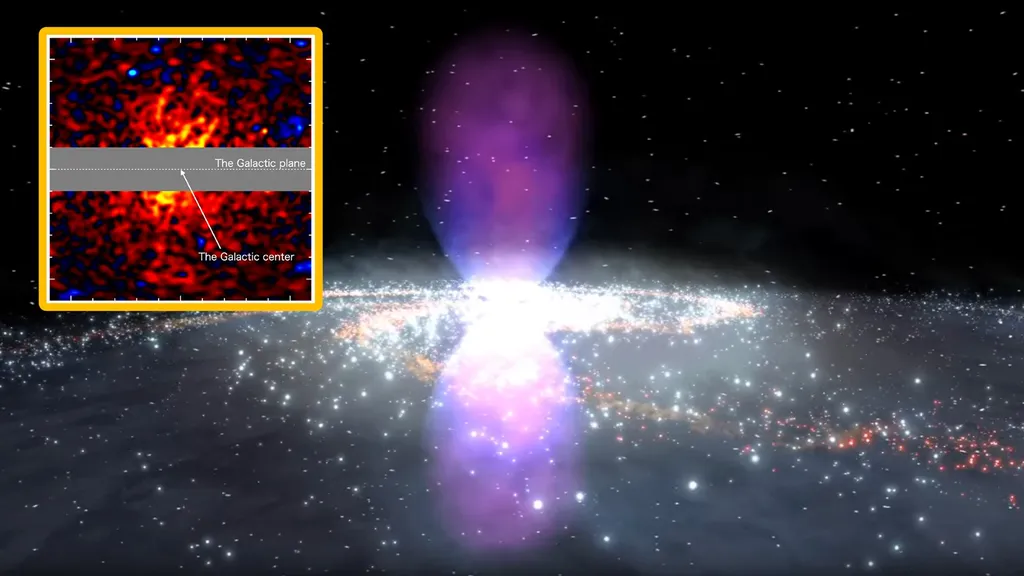
In the realm of particle physics and cosmology, a team of researchers from the University of Tokyo, including Tatsuya Aonashi, Shigeki Matsumoto, Yu Watanabe, and Yuki Watanabe, has been exploring the intriguing concept of sub-GeV dark matter. Their work, published in the Journal of High Energy Physics, delves into the possibilities of a type of dark matter known as “light WIMPs” (Weakly Interacting Massive Particles) and their interactions within a specific theoretical framework.
The researchers propose a model based on an additional gauge symmetry, U(1)B-L+xY, where B stands for baryon number, L for lepton number, Y for hypercharge, and x is a parameter that determines the coupling strengths. In this model, the new gauge boson interacts predominantly with dark matter and neutrinos, while its interactions with charged leptons are suppressed. This suppression is crucial because it allows the dark matter to annihilate almost exclusively into neutrinos, avoiding stringent constraints from cosmic microwave background (CMB) observations that limit energy injection from dark matter annihilation during recombination.
The team maps out the parameter space where the observed dark matter relic abundance can be reproduced through standard thermal freeze-out mechanisms within a conventional cosmological history. They find that significant regions of this parameter space remain viable after considering current cosmological, indirect detection, and terrestrial constraints. Interestingly, in part of the allowed parameter space, the dark matter exhibits sufficiently large self-interactions. These self-interactions could potentially help resolve tensions related to small-scale structure in the universe, such as the “missing satellite” problem and the “too big to fail” problem, which are discrepancies between observations and predictions of the standard cosmological model.
The practical implications for the energy sector, particularly in the context of dark matter research, are indirect but significant. Understanding the nature of dark matter could lead to advancements in fundamental physics, which in turn could inspire new technologies and approaches in energy production, storage, and efficiency. For instance, insights into particle interactions and symmetries could inform the development of advanced materials or novel energy conversion mechanisms. Additionally, the search for dark matter often pushes the boundaries of detector technology, which can have spin-off applications in various industries, including energy.
While the research is primarily theoretical and does not directly address energy applications, it contributes to the broader scientific understanding that could eventually influence energy technologies. The work highlights the importance of interdisciplinary research and the potential for fundamental discoveries to have far-reaching impacts. As the scientific community continues to explore the mysteries of dark matter, the energy sector can benefit from the innovative thinking and technological advancements that emerge from these investigations.
This article is based on research available at arXiv.