
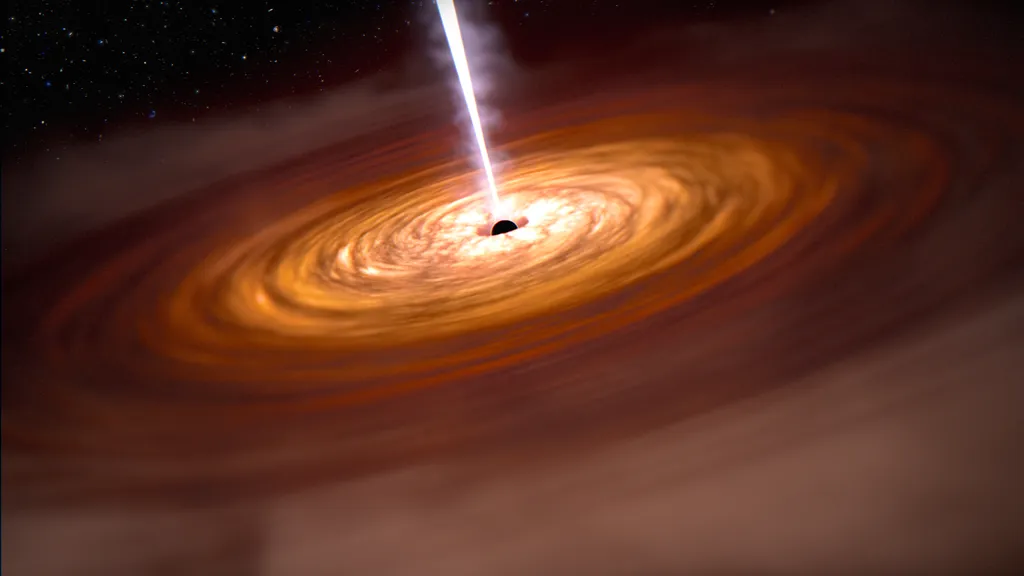
In the realm of energy and astrophysics, a team of researchers led by Ann Njeri from the University of Southampton, along with colleagues from various institutions including Durham University, the National Astronomical Observatory of Japan, and the European Southern Observatory, has been delving into the intricate world of quasars. Their work, recently published in the Astrophysical Journal, sheds light on the importance of sensitive radio imaging in identifying active galactic nuclei (AGN) even in the so-called “radio-quiet” regime.
The researchers presented new high-resolution radio imaging of 29 quasars, which are among the most luminous objects in the universe, powered by supermassive black holes. These quasars were selected from the expanded Quasar Feedback Survey (QFeedS) and are notable for their optical and [O III] luminosity, as well as their relatively low radio power. Despite being classified as “radio quiet,” the study revealed that nearly 31% of these quasars exhibit resolved radio structures consistent with compact jets or wind-driven outflows. Furthermore, about 90% displayed steep spectra indicative of optically thin synchrotron emission, a process where electrons spiral around magnetic fields and emit radio waves.
By combining morphological, spectral index, and brightness-temperature diagnostics, the researchers found that at least 38% of the sample showed clear AGN signatures that cannot be explained by star formation alone. This finding challenges the traditional dichotomy between “radio-loud” and “radio-quiet” quasars, suggesting that compact, low-power jets and AGN shocks are common even deep within the radio-quiet regime.
The implications of this research for the energy sector are profound. Understanding the feedback processes from quasars, particularly in the radio-quiet regime, can provide insights into the mechanisms driving energy output and particle acceleration in AGN. This knowledge can inform the development of more efficient and sustainable energy technologies, as well as contribute to our understanding of the fundamental processes governing the universe.
The study also highlights the importance of high-resolution radio imaging in identifying and studying AGN. As the researchers continue to expand the QFeedS sample, connecting these high-resolution radio observations with multi-wavelength observations will provide a more comprehensive understanding of quasar feedback processes. This integrated approach can offer valuable insights for the energy industry, particularly in the areas of plasma physics, particle acceleration, and energy conversion mechanisms.
In summary, the work of Ann Njeri and her colleagues represents a significant step forward in our understanding of quasars and AGN. By revealing the prevalence of AGN-driven synchrotron activity in the radio-quiet regime, this research not only advances our knowledge of astrophysical phenomena but also holds practical applications for the energy sector. As we continue to explore the cosmos, the insights gained from such studies will undoubtedly contribute to the development of innovative energy technologies and solutions.
This article is based on research available at arXiv.