
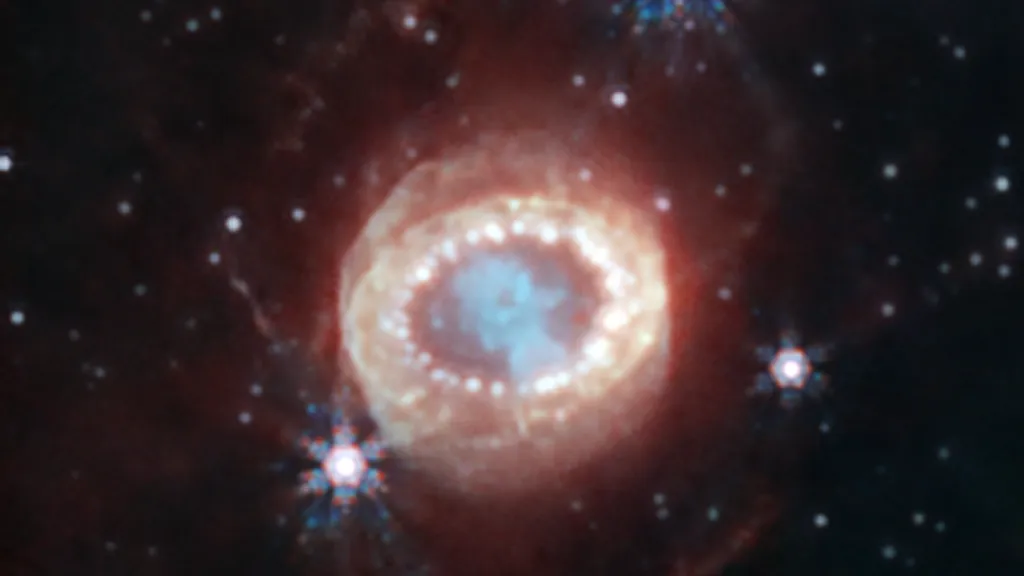
Researchers Mingxi Chen, Kazumi Kashiyama, and Masato Sato from the University of Tokyo have published a study in the Astrophysical Journal that explores the dynamics of rapidly spinning, strongly magnetized neutron stars, known as pulsars, and their impact on supernova explosions. Their work focuses on the formation of wind bubbles around these pulsars and the subsequent blowouts that can occur, which may have implications for our understanding of certain types of supernovae and their energy output.
The research team conducted multidimensional numerical studies to construct a semi-analytic framework that follows the post-blowout dynamics and radiative evolution of these events. They mapped the conditions under which blowouts occur by scanning various parameters of the supernova ejecta and the neutron star. The study also computed survey-ready multi-band light curves to better understand the observable characteristics of these phenomena.
For stripped-envelope supernovae, which have an ejecta mass of around 10 solar masses and an explosion energy of about 10^51 ergs, the researchers found that blowouts can occur if the neutron star has a magnetic field strength greater than 10^13 Gauss and a spin period of less than a few milliseconds. In cases where the magnetic field is relatively weak (less than 10^14 Gauss), the blowout can produce luminous double-peaked UV/optical light curves, similar to those observed in the superluminous supernova LSQ14bdq. For stronger magnetic fields (greater than 10^14 Gauss), the blowout can result in hypernovae, which are preceded by X-ray blowout precursors.
The study also examined weaker and lower-mass supernova explosions, such as ultra-stripped supernovae and accretion- or merger-induced collapse events. In these cases, blowout is more readily achieved over a broader range of neutron star parameters, producing fast X-ray transients with durations of 10^2 to 10^4 seconds and peak luminosities of 10^42 to 10^48 ergs per second.
The researchers suggest that coordinated UV, optical, and X-ray observations could help constrain the formation of the most energetic neutron stars in the universe. This work provides valuable insights into the complex interplay between pulsars and supernovae, which can have significant implications for our understanding of stellar evolution and the energy output of these cosmic events.
The research was published in the Astrophysical Journal, a leading journal in the field of astrophysics and space science.
This article is based on research available at arXiv.