
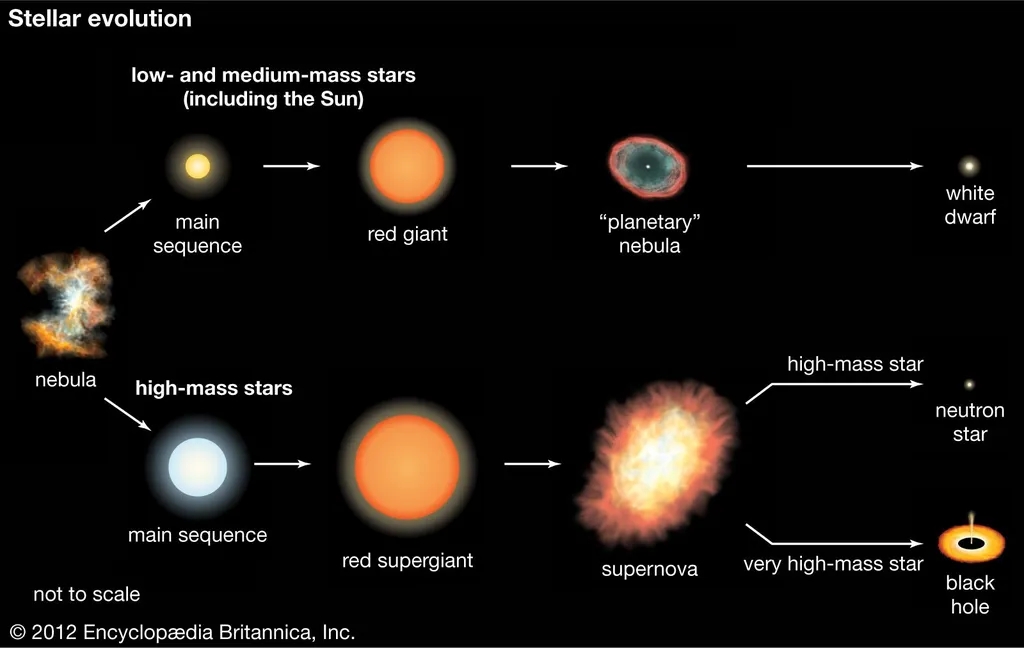
Researchers Shuai Zha, Han Lin, Xuefei Chen, and Zhanwen Han from the National Astronomical Observatories of the Chinese Academy of Sciences have published a study in the Astrophysical Journal that explores the mechanisms behind pre-supernova eruptions in low-mass stars. Their findings could have implications for understanding stellar evolution and, by extension, the energy industry’s reliance on nuclear processes.
The study focuses on low-mass stars, specifically those with masses between 9 and 10 times that of our Sun, which are progenitors of core-collapse supernovae (CCSNe). The researchers found that nuclear burning beyond oxygen can become explosive under certain conditions, leading to eruptive mass loss before the final supernova explosion. This process is triggered by the deposition of nuclear energy in the star’s outer layers, which includes the helium layer and the hydrogen-rich envelope.
Using hydrodynamic simulations and realistic stellar models, the researchers parameterized the nuclear energy deposition and investigated how it affects the star’s mass loss. They discovered that for the lowest-mass model (9 solar masses), the amount of mass ejected scales with the energy gained by the hydrogen-rich envelope, following a power law with an index of approximately 3.5. This relationship holds true across the 9-10 solar mass range, with limited scatter within a factor of about 2.6. This finding enables astronomers to estimate the energy gained by the envelope from the observed mass of the ejecta.
The researchers also found that the passage of the shock wave through the star’s envelope flattens the bound envelope, which can affect the supernova light curve morphology. This provides another diagnostic tool for studying these pre-supernova eruptions. To aid future studies, the researchers have made their post-eruption stellar profiles and precursor light curves publicly available.
The study’s findings contribute to our understanding of stellar evolution and the processes that lead to supernovae. While the direct implications for the energy industry may not be immediately apparent, a deeper understanding of nuclear processes in stars can inform the development of nuclear fusion technologies, which are a promising area of research for clean, sustainable energy production. The research was published in the Astrophysical Journal.
This article is based on research available at arXiv.