
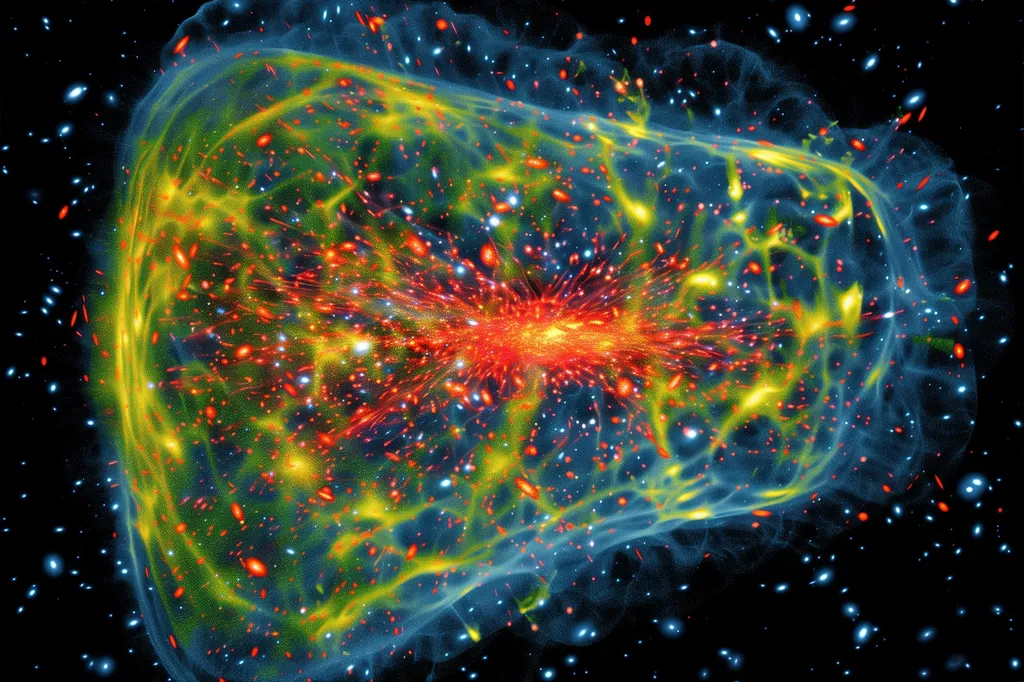
Researchers from the University of Pennsylvania, including Rafael C. H. Gomes, Kyle Miller, Sunao Sugiyama, Jonathan Blazek, Thomas Bakx, and Bhuvnesh Jain, have recently published a study that delves into the intricate world of cosmic shear and intrinsic alignment. Their work, titled “Tidal alignment and tidal torquing modeling for the cosmic shear three-point correlation function and mass aperture skewness,” offers a nuanced look at how intrinsic alignments can affect cosmological measurements, which is particularly relevant for the energy industry as it increasingly turns to space-based technologies for monitoring and prediction.
The team’s research focuses on the tidal alignment and tidal torquing (TATT) formalism, a model that describes how galaxies align with the gravitational field around them. This alignment can contaminate cosmological measurements, such as the shear three-point correlation function and the skewness of the mass aperture statistic, which are crucial for understanding the distribution of matter in the universe. The researchers computed the intrinsic alignment bispectra components using the TATT model parameters and compared the impact of changing between different models on the theoretical computation of the three-point correlation function (3PCF).
They found that the TATT model significantly impacts the skewed triangle configurations of the 3PCF. Moreover, including higher-order effects from TATT can have differing impacts on the two-point function and the mass aperture skewness, damping the signal of the former while boosting the signal of the latter. This dual effect underscores the complexity of intrinsic alignments and their potential to influence cosmological measurements.
The researchers argue that a joint 2PCF+3PCF analysis with the TATT model can help break the degeneracy between its model parameters and provide more robust constraints on both cosmology and intrinsic alignment amplitude parameters. They demonstrated that typical values of order unity for the intrinsic alignment parameters introduce differences of around 10% between NLA (Non-Linear Alignment) and TATT predictions. This finding highlights the importance of considering intrinsic alignments in cosmological analyses to ensure accurate and reliable results.
The research was published in the journal Physical Review D, a prestigious publication in the field of astrophysics and cosmology. The insights gained from this study are not only academically significant but also practically relevant for the energy sector, particularly in the context of space-based technologies and satellite monitoring. As the energy industry continues to explore and utilize these technologies, a deeper understanding of cosmic phenomena and their potential impacts on measurements will be increasingly valuable.
In summary, the work of Gomes and his colleagues sheds light on the nuanced ways in which intrinsic alignments can affect cosmological measurements, offering valuable insights for both the scientific community and the energy industry. Their findings underscore the importance of considering these effects in future analyses and highlight the potential of joint 2PCF+3PCF approaches to provide more robust constraints on cosmological parameters.
This article is based on research available at arXiv.