
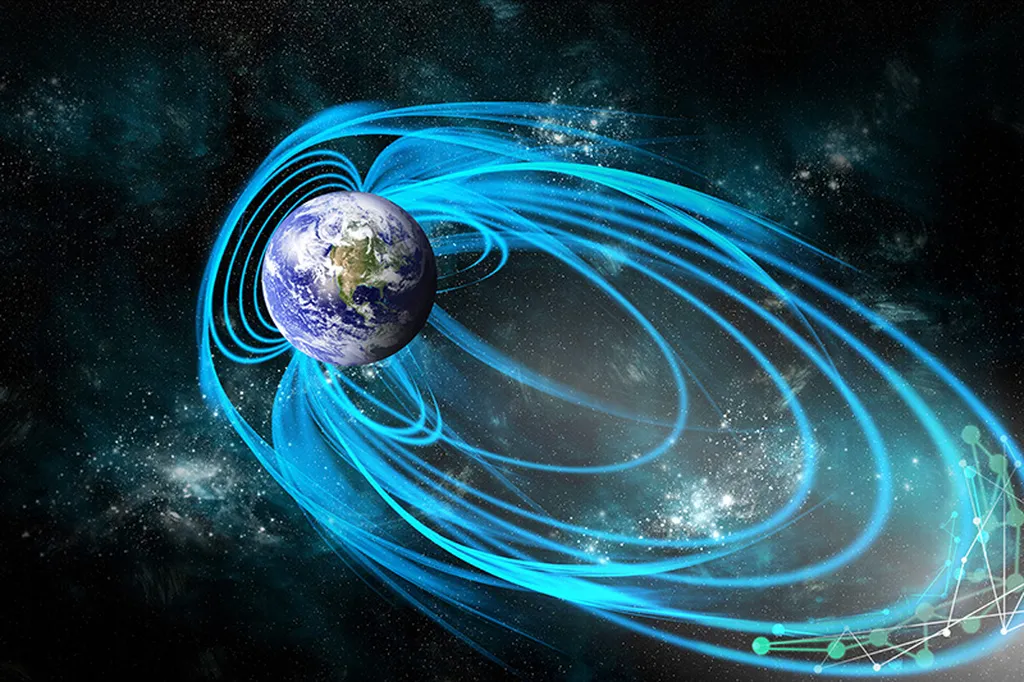
In the realm of space weather monitoring and prediction, a trio of researchers from the University of California, Berkeley—Pranjal Patil, Anli Ji, and Berkay Aydin—have developed a novel framework that could significantly enhance the interpretability and practicality of machine learning models used in forecasting solar energetic particle (SEP) events. Their work, published in the journal Nature Communications, introduces a Physics-Guided Counterfactual Explanation framework designed to generate explanations that are not only mathematically sound but also physically plausible and actionable.
Solar energetic particle events pose substantial risks to satellites, astronauts, and other space-based infrastructure. Accurate prediction of these events is crucial for implementing timely protective measures. Modern space weather monitoring systems, such as the Geostationary Operational Environmental Satellites (GOES), generate vast amounts of high-frequency, multivariate time series data. While machine learning models trained on this data have shown strong predictive power, they often overlook domain-specific feasibility constraints, leading to explanations that may not be physically realistic or actionable.
The researchers’ framework addresses this gap by introducing a method for generating counterfactual explanations in time series classification tasks that remain consistent with underlying physical principles. Counterfactual explanations are scenarios that contrast with the actual observed data to illustrate what would have happened under different conditions. By ensuring these explanations are physically plausible, the framework makes the predictions more interpretable and actionable for scientists and engineers in the field.
The framework achieves over an 80% reduction in Dynamic Time Warping (DTW) distance, a measure of similarity between time series, compared to state-of-the-art baselines such as DiCE. This reduction indicates that the generated counterfactual explanations are closer to the actual data, making them more relevant and useful. Additionally, the framework produces counterfactual explanations with higher sparsity, meaning they involve fewer changes to the original data, and reduces runtime by nearly 50%. These improvements make the framework both more efficient and more scalable for big data environments.
For the energy sector, particularly in space-based applications, this research has significant implications. Accurate and interpretable predictions of solar energetic particle events can help in the design and operation of satellites and other space infrastructure, ensuring their resilience against space weather events. The framework’s ability to generate physically plausible and actionable explanations can aid in decision-making processes, ultimately safeguarding critical assets and personnel in space.
In summary, the Physics-Guided Counterfactual Explanation framework developed by Patil, Ji, and Aydin represents a significant advancement in the field of space weather prediction. By combining machine learning with domain-specific physical constraints, the framework provides a powerful tool for generating interpretable and actionable predictions, laying the foundation for more robust and scalable solutions in the energy sector.
This article is based on research available at arXiv.