
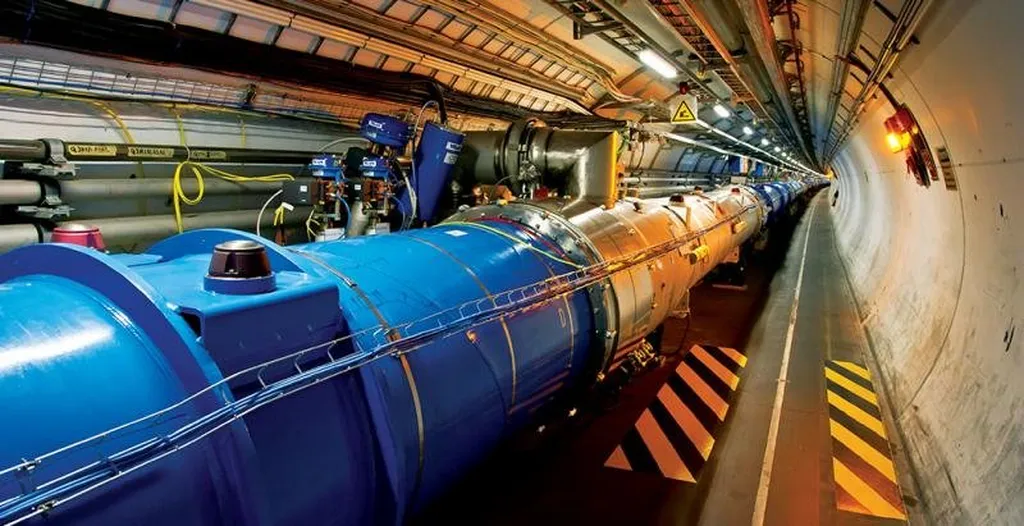
In the realm of high-energy physics, a team of researchers from various institutions, including Yin-Fa Shen from the University of California, Irvine, Alfredo Gurrola from the University of Kansas, Francesco Romeo from the University of Hamburg, Denis Rathjens from the University of Bonn, and Andres Flórez from the University of Antioquia, have proposed a novel strategy to probe heavy neutrinos at the Large Hadron Collider (LHC). Their work, published in the journal Physical Review Letters, leverages advanced machine-learning algorithms to enhance the discovery potential of these elusive particles.
Heavy neutrinos, which are hypothetical particles predicted by some extensions of the Standard Model of particle physics, could play a crucial role in understanding the matter-antimatter asymmetry in the universe and the nature of neutrino masses. The researchers focused on proton-proton collisions at the LHC, specifically looking for final states containing a charged lepton, missing transverse energy, and two jets. This approach allows them to probe heavy neutrino masses ranging from 50 GeV to 10 TeV, a range that spans from the electroweak scale to the multi-TeV frontier.
For heavy neutrino masses below approximately 1 TeV, the production is dominated by the s-channel process, where a virtual particle mediates the interaction. At higher masses, vector boson fusion becomes the dominant production mechanism. This process involves two vector bosons merging to produce a heavy neutrino, and its cross section decreases slowly as the heavy neutrino mass increases. The researchers simulated both signal and Standard Model background events and employed gradient-boosted decision trees, a type of machine-learning algorithm, to optimize event classification.
Assuming an integrated luminosity of 3000 fb⁻¹, expected for the high-luminosity LHC, the researchers found that their approach could probe heavy neutrinos with sensitivity to the mixing parameter |VℓN|² spanning from 10⁻⁵ to 1. This parameter represents the strength of the interaction between the heavy neutrino and the known leptons. The proposed strategy enhances the discovery potential for heavy neutrinos and provides a complementary pathway to existing search strategies, offering new insights into the fundamental nature of matter and energy.
While this research is primarily of interest to the field of particle physics, it also has implications for the energy sector. Understanding the fundamental particles and forces that govern the universe can lead to breakthroughs in energy production, storage, and transmission. For instance, advances in particle physics could pave the way for more efficient and sustainable energy technologies, such as fusion energy, which aims to replicate the processes that power the sun. Moreover, the use of machine-learning algorithms in this research highlights the growing role of data science and artificial intelligence in driving innovation across various industries, including energy.
In conclusion, the proposed strategy for probing heavy neutrinos at the LHC offers a promising avenue for advancing our understanding of the fundamental building blocks of the universe. By leveraging advanced machine-learning techniques, the researchers have enhanced the discovery potential for these elusive particles, providing valuable insights into the nature of matter and energy. While the direct applications to the energy sector may be indirect, the broader implications of this research could contribute to the development of more sustainable and efficient energy technologies in the future.
This article is based on research available at arXiv.