
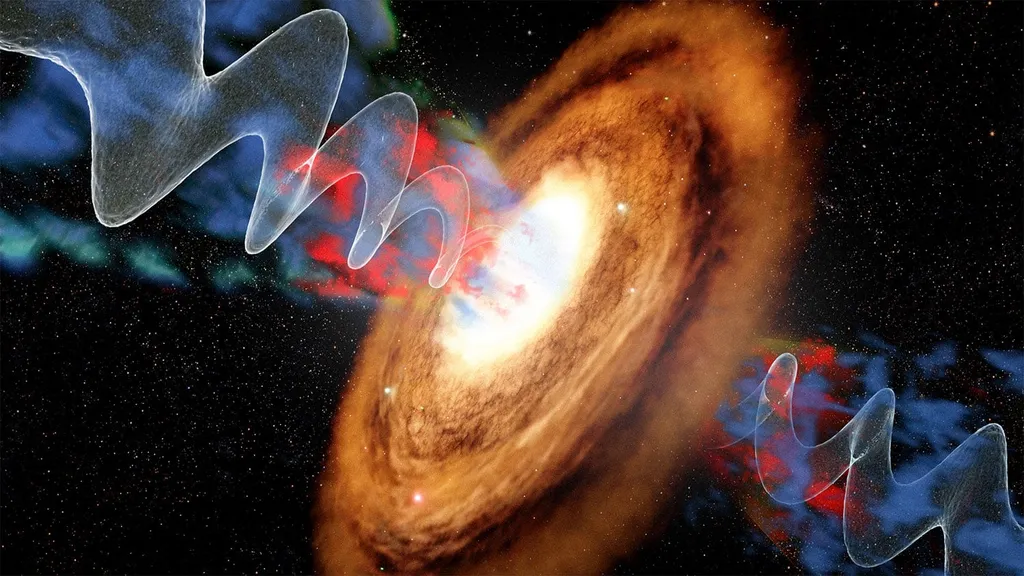
In a recent study published in the journal Nature, a team of researchers led by Justin A. Kader from the University of California, Irvine, has shed new light on the intricate relationship between supermassive black holes and their host galaxies. The team, comprising astronomers and astrophysicists from various institutions, investigated the active galaxy VV 340a, which harbors a low-power jet emanating from its central supermassive black hole.
The researchers combined observations from multiple wavelengths, including optical, infrared, sub-millimeter, and radio, to study the dynamics of the galaxy. They discovered that the jet from the supermassive black hole undergoes a process called precession, where it wobbles like a spinning top, with a period of approximately 820,000 years. This precessing jet drives a significant outflow of gas from the galaxy at a rate of about 19.4 solar masses per year. The jet’s interaction with the gas creates highly ionized plasma that extends several kiloparsecs from the galaxy’s nucleus.
This study provides crucial insights into the feedback mechanisms that regulate star formation in massive galaxies. The outflow of gas driven by the precessing jet is substantial enough to influence the galaxy’s star formation rate. This finding aligns with theoretical models that require feedback from active galactic nuclei to reproduce observed galaxy properties. However, the energetics and timescales of these feedback processes have been poorly constrained until now.
For the energy sector, understanding these feedback mechanisms is vital as they can impact the interstellar medium and the availability of gas for star formation, which in turn affects the evolution of galaxies and their energy output. This research highlights the importance of considering the dynamic nature of supermassive black hole jets and their role in shaping the evolution of their host galaxies. The practical applications for the energy sector include refining models of galaxy evolution and energy production, which can inform strategies for sustainable energy development and resource management.
The study, titled “A precessing jet from an active galactic nucleus drives gas outflow from a disk galaxy,” was published in the journal Nature, providing a significant advancement in our understanding of the complex interplay between supermassive black holes and their host galaxies.
This article is based on research available at arXiv.