
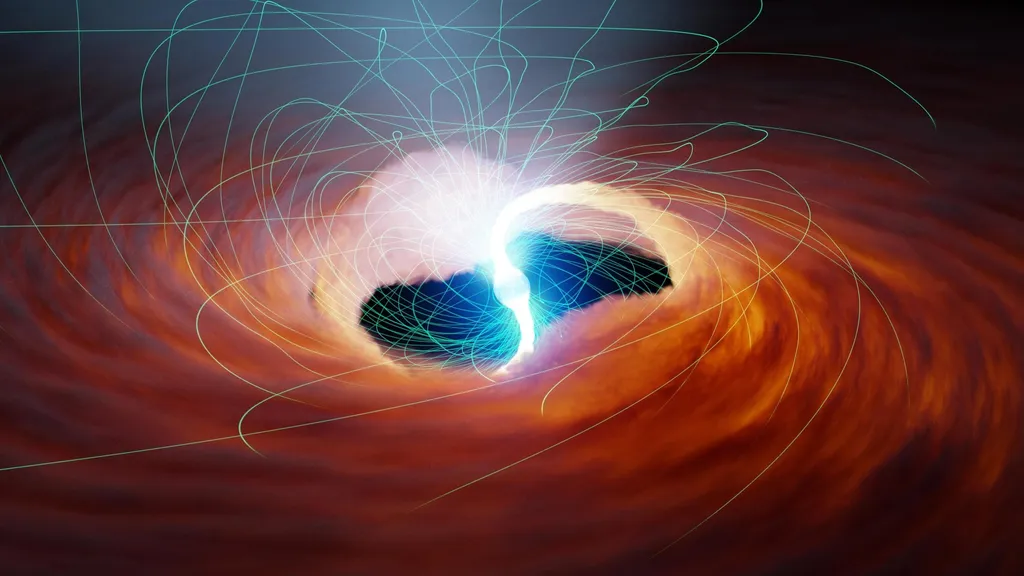
In the realm of energy and astrophysics, a team of researchers from the University of Leicester and the University of Tübingen has made significant strides in understanding ultraluminous X-ray sources (ULXs), which are critical in the study of high-energy astrophysical phenomena. Led by Sinan Allak, Aysun Akyuz, Yasemin Aladag, Lorenzo Ducci, and Andrea Santangelo, this research delves into the nature of these enigmatic sources, providing valuable insights that could have implications for the energy sector, particularly in the development of advanced energy technologies and understanding the behavior of high-energy particles.
The researchers focused their study on the galaxies NGC 4631 and NGC 1097, utilizing archival data from Chandra, XMM-Newton, and Swift/XRT observations. Their analysis spanned from 2000 to 2025, allowing them to identify new ULXs and investigate their X-ray and optical properties. The team performed spectral fitting for sources with sufficient counts using absorbed power-law and diskbb models. They also conducted variability analyses, including hardness-intensity diagrams and light curves, to assess both short- and long-term variability. Additionally, optical color-magnitude diagrams and near-infrared (NIR) spectral energy distributions (SEDs) were employed to identify possible donor stars.
In NGC 4631, the researchers identified two new transient ULXs, X-6 and X-7, which exhibited X-ray count rates varying by more than an order of magnitude. The LX-T^4 relation from diskbb fits provided strong evidence that NGC 4631 X-6 is powered by a stellar-mass black hole accreting via a standard disk. The optical sources within the X-ray error circles of X-6 and X-7 were identified as candidate counterparts, suggesting these systems are candidate high-mass X-ray binaries (HMXBs). In NGC 1097, the team discovered a new transient ULX, ULX-3, which showed X-ray luminosity variations by a factor of about 30 and evidence for spectral state transitions. This ULX could be consistent with either a stellar-mass black hole or a neutron star. The researchers identified a unique optical and NIR counterpart for ULX-3, with the NIR SED consistent with a blackbody temperature of about 3300 K, compatible with a red supergiant donor with a radius of about 200 solar radii.
The practical applications of this research for the energy sector are manifold. Understanding the behavior of ULXs and their underlying mechanisms can provide insights into the physics of accretion and high-energy particle interactions, which are relevant to the development of advanced energy technologies. For instance, the study of stellar-mass black holes and their accretion processes can inform the design of more efficient and sustainable energy systems. Additionally, the identification of candidate HMXBs and their optical counterparts can aid in the development of new detection and monitoring techniques for high-energy astrophysical phenomena, which can be applied to energy-related research and development.
This research was published in the journal Astronomy & Astrophysics, contributing to the growing body of knowledge in the field of high-energy astrophysics and its potential applications in the energy sector.
This article is based on research available at arXiv.