
In the realm of space plasma physics, a persistent puzzle has been the origin of ‘anomalous’ resistivity in magnetic reconnection, a process that plays a crucial role in various astrophysical phenomena and energy systems. Researchers like Magnus F Ivarsen, affiliated with institutions at the forefront of plasma research, have been delving into this enigma to shed light on its underlying mechanisms.
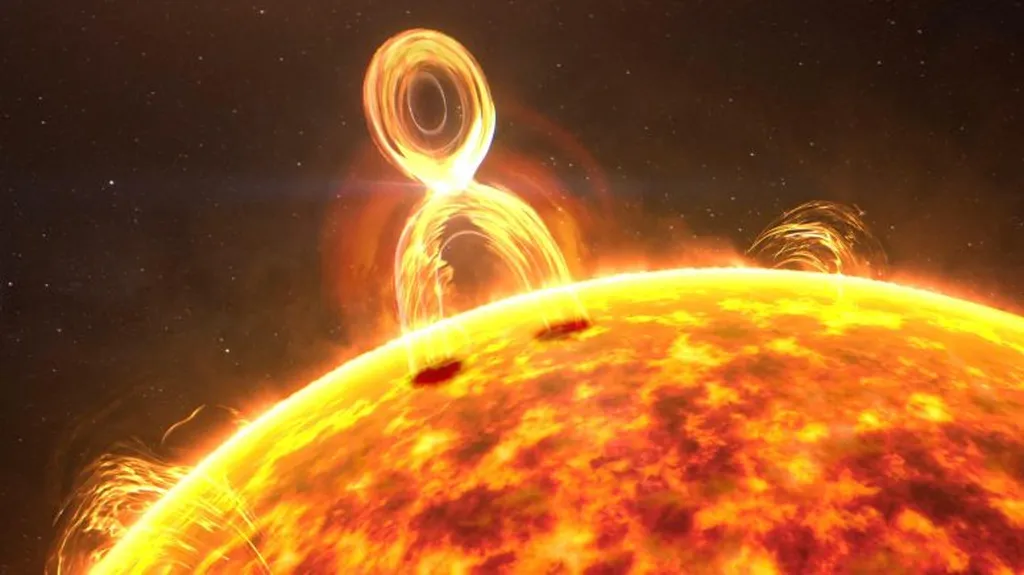
Magnetic reconnection is a process where magnetic field lines in a plasma break and reconnect, releasing energy. This process is often faster than classical theories predict, and this discrepancy is often attributed to ‘anomalous’ resistivity, which is resistivity beyond what is expected from standard theories. The Bohm diffusion scaling, which describes how resistivity changes with temperature and magnetic field strength, has been widely used to explain these fast reconnection rates, but until now, it lacked a solid theoretical foundation.
In a recent study, Ivarsen and his team have provided a rigorous derivation of the Bohm diffusion scaling by modeling the magnetized electron fluid as an overdamped spintronic condensate. They used the Landau-Lifshitz-Gilbert equation, which is typically used to describe the dynamics of magnetic systems, to model the plasma. The researchers demonstrated that the breakdown of the “frozen-in” condition, a fundamental principle in plasma physics, is a topological phase transition where electron gyro-axes lose synchronization with the magnetic field. This transition is identified as an Adler-Ohmic bifurcation, a concept from condensed matter physics.
The team also showed that the breakdown of adiabatic invariance, another key principle in plasma physics, maps to electron gyro axis slippage on the unit sphere. The resulting resistivity naturally saturates at the Bohm limit, providing a solid theoretical basis for the empirical scaling. The research was published in the journal Physical Review Letters, a prestigious journal in the field of physics.
Numerical simulations of the XY universality class, a concept from statistical physics, confirmed that the onset of this resistive state is explosive, following a logistic trigger consistent with the impulsive phase of solar flares. The topological defects in the condensate decay via a t^-0.75 power law, identifying magnetic island coalescence as the mechanism of anomalous transport.
For the energy industry, understanding magnetic reconnection and resistivity is crucial for several applications. It can help in improving the design and operation of fusion reactors, which aim to harness the energy of the sun here on earth. It can also aid in understanding and predicting space weather events, which can disrupt power grids and satellite communications. Furthermore, it can provide insights into the behavior of plasmas in industrial applications, such as in plasma cutting and welding.
In conclusion, this research provides a significant advance in our understanding of magnetic reconnection and resistivity. By establishing a rigorous theoretical foundation for the Bohm diffusion scaling, it paves the way for more accurate modeling and prediction of plasma behavior in various energy systems and astrophysical phenomena.
This article is based on research available at arXiv.