
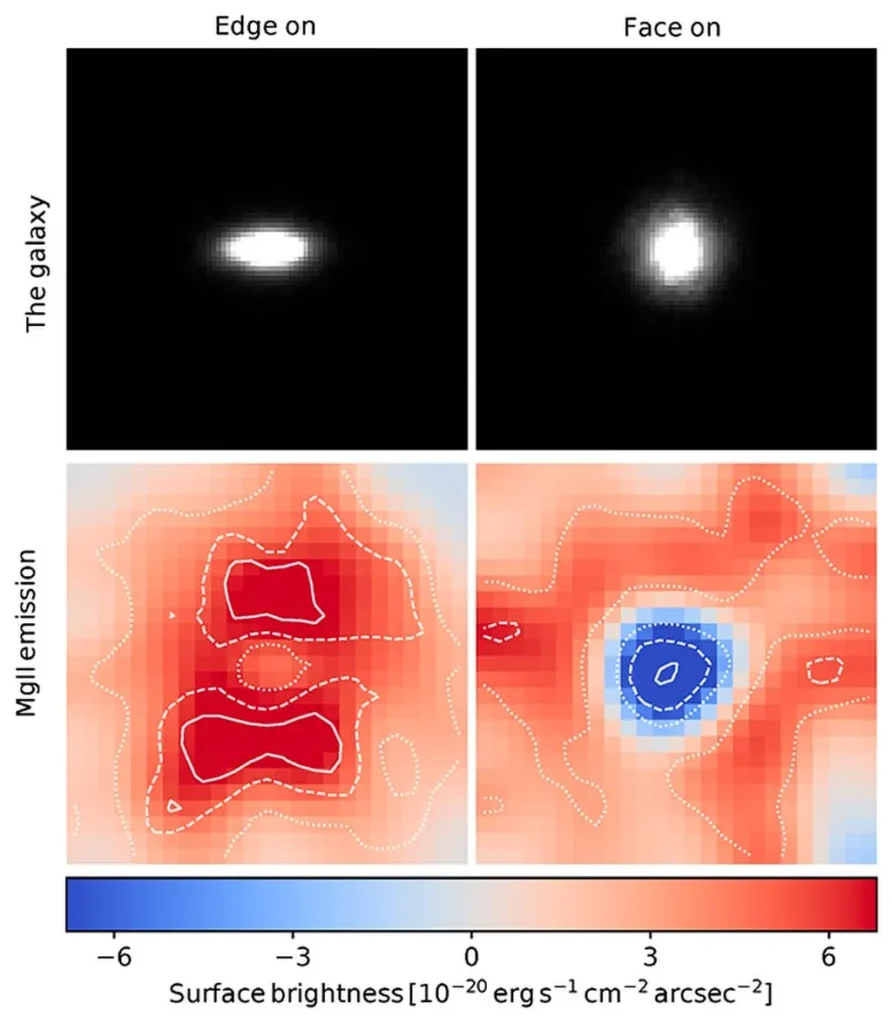
In the realm of energy journalism, it’s crucial to stay abreast of scientific research that could potentially impact the energy sector. Today, we delve into a study that explores the variations in metal loading of galactic winds, a topic that might seem astronomically distant but could have implications for our understanding of stellar nucleosynthesis and, by extension, the energy industry.
The research was conducted by Aditi Vijayan, Mark R. Krumholz, and Benjamin D. Wibking, all affiliated with the Research School of Astronomy and Astrophysics at the Australian National University. Their work, titled “QED V: Variations in metal loading of galactic winds with element nucleosynthetic origin,” was published in the Monthly Notices of the Royal Astronomical Society.
The study focuses on the role of different stellar processes in enriching the interstellar medium with metals. Specifically, it investigates type Ia supernovae, type II supernovae, and asymptotic giant branch (AGB) stars, which are all important sites of stellar nucleosynthesis. These processes differ greatly in their rates, their location within a galaxy, and the mean thermal energy and abundance distribution of their ejecta.
In previous research, the team had shown that a significant fraction of metals newly synthesized by type II supernovae are promptly lost to galactic winds, a phenomenon known as metal loading. In this study, they sought to determine whether the elements returned by type Ia supernovae and AGB stars are similarly metal loaded, or if metal loading varies significantly with the nucleosynthetic site.
Using high-resolution simulations of the interstellar medium, the researchers systematically varied the galaxy gas surface density, metallicity, and the scale heights and relative rates of the different nucleosynthetic sources. They found that the metal loadings of galactic winds differ substantially between metals produced by different sources, with typical variations at the level of approximately 0.3 dex. This phenomenon, which they term differential metal loading, is not easily predictable a priori and varies depending on the galactic environment.
The findings of this study have significant implications for the interpretation of diagnostics of galaxy formation, such as star formation timescales and initial mass functions. These techniques often rely on abundance diagnostics, which can be influenced by differential metal loading at levels comparable to those observed in the study.
So, how does this research relate to the energy industry? While the study itself is focused on astrophysics, the underlying principles of nucleosynthesis and metal loading could have implications for our understanding of stellar evolution and the life cycles of stars. This, in turn, could impact our understanding of the universe’s energy dynamics and the potential for harnessing energy from stellar processes. Furthermore, the study’s findings could influence the development of models used to predict the behavior of stars and galaxies, which could have applications in the energy sector, such as in the development of fusion energy technologies.
In conclusion, while the research may seem esoteric, it underscores the interconnectedness of scientific disciplines and the potential for seemingly unrelated fields to inform and advance one another. As we continue to explore the cosmos, we may uncover insights that bring us closer to unlocking the universe’s energy potential.
This article is based on research available at arXiv.