
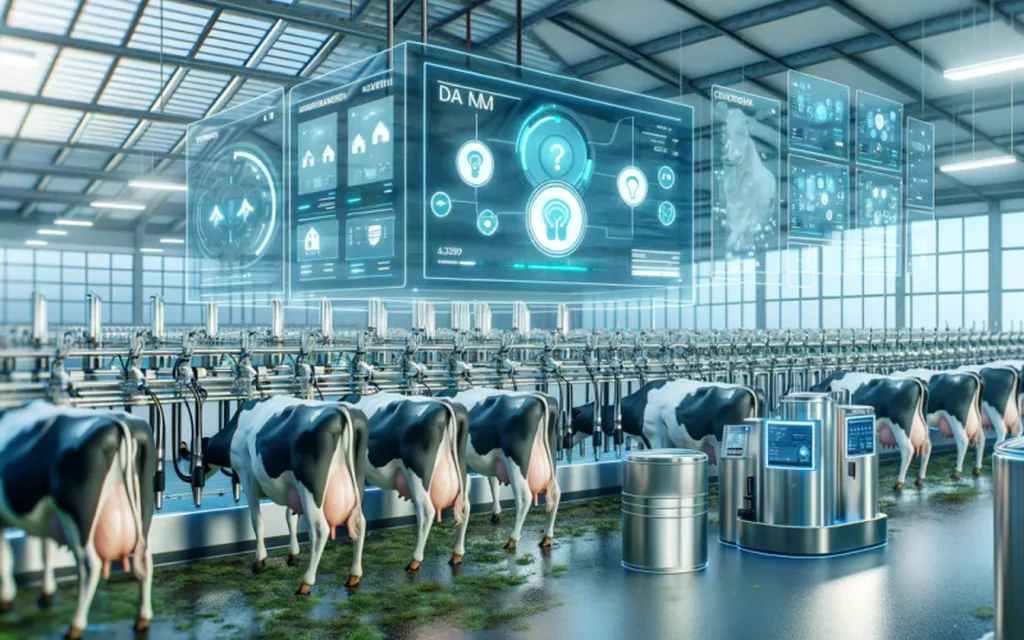
In the quest for more sustainable and efficient energy management, researchers Nawazish Ali, Rachael Shaw, and Karl Mason from the University of Auckland have developed a novel approach to optimize electricity load scheduling in dairy farms. Their work, published in the journal Applied Energy, addresses the challenges posed by the increasing integration of renewable energy sources into the grid.
Dairy farming is an energy-intensive sector that heavily relies on grid electricity. As the world moves towards more sustainable energy solutions, it is crucial to reduce grid dependence and manage energy efficiently. The intermittent nature of renewable energy sources makes balancing supply and demand in real-time a significant challenge. Intelligent load scheduling can help minimize operational costs while maintaining reliability.
The researchers propose a Deep Reinforcement Learning (DRL) framework tailored for dairy farms, focusing on battery storage and water heating under realistic operational constraints. Their approach, called Forecast Aware Proximal Policy Optimization (PPO), incorporates short-term forecasts of demand and renewable generation. This is achieved through hour of day and month-based residual calibration, which helps adapt to the dynamic nature of energy supply and demand.
One of the key innovations in their study is the use of a Proportional Integral Derivative (PID) controller to regulate KL divergence for stable policy updates adaptively. This PID KL PPO variant ensures that the learning process remains stable even under variable tariffs, a common challenge in real-world scenarios.
The researchers trained their model on real-world dairy farm data and found that their method achieved up to 1% lower electricity costs compared to standard PPO, 4.8% lower than Deep Q-Networks (DQN), and 1.5% lower than Soft Actor-Critic (SAC). For battery scheduling, the PPO method reduced grid imports by 13.1%, demonstrating its effectiveness in managing energy more sustainably.
This research highlights the potential of advanced machine learning techniques in optimizing energy use in energy-intensive sectors like dairy farming. By reducing operational costs and grid dependence, such methods can contribute significantly to the United Nations Sustainable Development Goal 7 on affordable and clean energy. The practical applications of this research extend beyond dairy farming to other sectors looking to integrate renewable energy sources and manage their energy consumption more efficiently.
The study, titled “Forecast Aware Deep Reinforcement Learning for Efficient Electricity Load Scheduling in Dairy Farms,” was published in the journal Applied Energy.
This article is based on research available at arXiv.