
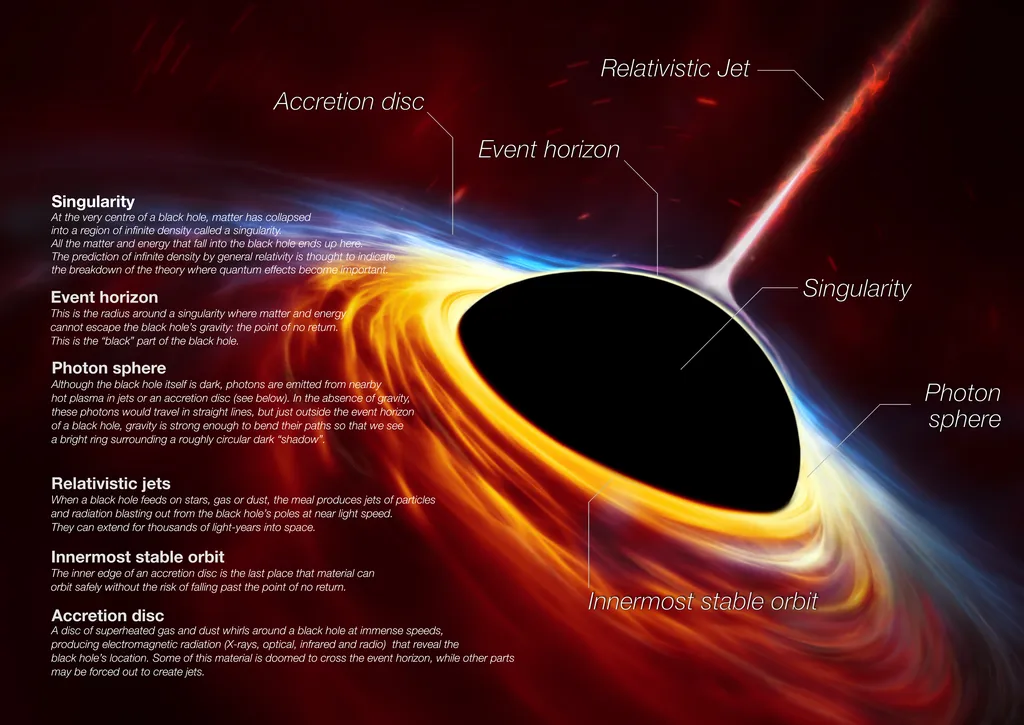
Researchers Marc S. Klinger, Jonah Kudler-Flam, and Gautam Satishchandran from the University of California, Berkeley, have published a study that delves into the complex world of quantum gravity and its implications for the entropy of black holes and de Sitter spacetime. Their work, titled “Generalized Entropy is von Neumann Entropy II: The complete symmetry group and edge modes,” was published in the journal Physical Review D.
The researchers built upon previous work that suggested the backreaction of gravitons on spacetime causes fluctuations in the area of a black hole’s horizon. These fluctuations, in turn, impose constraints on the algebra of physical observables in the subregion. The team showed that at the same perturbative order, gravitational backreaction also causes angle-dependent fluctuations in the horizon area. These fluctuations are encoded in horizon charges, or “edge modes,” which are related to an infinite-dimensional “boost supertranslation” symmetry of the horizon.
The researchers constructed the full algebra of observables that satisfies these constraints and argued that the resulting algebra is Type II. They found that the entropy of any “semiclassical state” includes an additional “edge mode” contribution, as well as a state-independent constant. Importantly, they discovered that for any black hole spacetime, the algebra has no maximum entropy state and is Type II-infinity.
In the context of de Sitter spacetime, the static patch is defined relative to the worldline of a localized “observer.” The researchers showed that a consistent quantization of the static-patch algebra requires a more realistic model of the observer, one that accounts for higher multipole moments that perturb the “shape” of the cosmological horizon. They argued that a proper account of the observer’s rotational kinetic energy and (non-gravitational) binding energy implies that the algebra is of Type II-1 and thereby admits a maximum entropy state.
While this research is highly theoretical, it has potential implications for our understanding of black hole thermodynamics and the entropy of spacetime itself. In the energy industry, a deeper understanding of these fundamental concepts could one day lead to advances in energy generation and storage, particularly in areas where quantum mechanics and gravity play a significant role, such as in the development of advanced nuclear fusion technologies. However, these applications are still far off, and much more research will be needed to bridge the gap between theoretical physics and practical energy solutions.
This article is based on research available at arXiv.