
In the realm of astrophysics and energy research, a team of scientists from Columbia University, including Dhruv K. Desai, Luciano Combi, Daniel M. Siegel, and Brian D. Metzger, have been delving into the intriguing phenomena of millisecond proto-magnetars and their potential to launch relativistic jets. Their findings, published in the journal Nature Astronomy, offer valuable insights that could have implications for our understanding of gamma-ray bursts (GRBs) and other energetic astrophysical events.
Millisecond proto-magnetars are rapidly rotating, strongly magnetized neutron stars that form in various stellar events such as core-collapse supernovae, neutron star mergers, and white dwarf accretion-induced collapse. These objects have long been proposed as the central engines driving GRBs and accompanying supernovae or kilonovae. However, a significant challenge has been the potential limitation on the magnetization and achievable Lorentz factors of the outflow due to neutrino heating driving baryon-rich winds from the neutron star surface within the first few seconds after birth.
The research team conducted 3D general-relativistic magnetohydrodynamic simulations of neutrino-heated proto-magnetar winds, incorporating M0 neutrino transport. Their simulations revealed essential multidimensional effects that had not been fully captured by previous analytic estimates and one-dimensional models. For rapidly rotating models with spin periods of 1 millisecond, centrifugal forces were found to enhance mass loss near the rotational equator, producing a dense, sub-relativistic outflow with velocities around 0.1 times the speed of light.
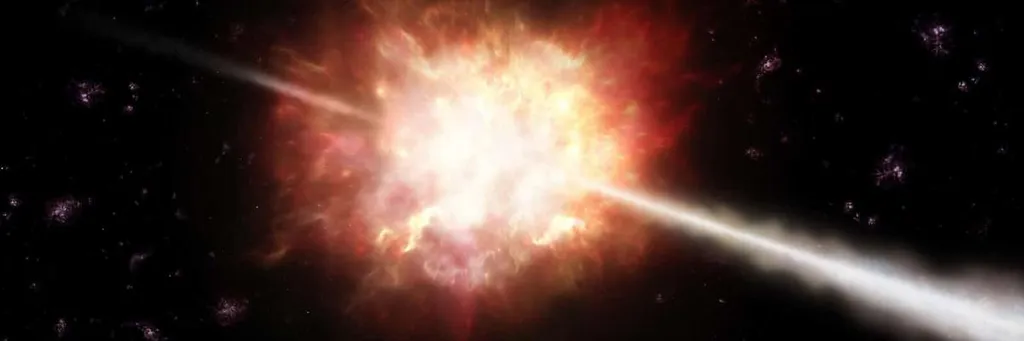
This equatorial wind, in turn, naturally confines and collimates less baryon-loaded outflows emerging from higher latitudes. This process leads to the formation of a structured bipolar jet with a peak magnetization of up to 30-100 along the pole. Such magnetization is sufficient to achieve bulk Lorentz factors of around 100 on larger scales. The resulting angular stratification of the outflow energy into ultra-relativistic polar and sub-relativistic equatorial components aligns broadly with observations of the energy partition between beaming-corrected GRB energies and supernova/kilonova ejecta.
The practical implications of this research for the energy sector are primarily indirect but significant. Understanding the mechanisms behind relativistic jets and their role in powering GRBs and other energetic astrophysical events can provide deeper insights into the fundamental processes governing energy transfer and conversion in extreme environments. This knowledge can inform theoretical models and simulations used in various energy research areas, including nuclear fusion, plasma physics, and astrophysical energy generation.
Moreover, the study highlights the potential role of millisecond proto-magnetars in powering the diverse electromagnetic counterparts of compact-object explosions. This could have implications for the development of advanced energy detection and monitoring technologies, as well as for the interpretation of observational data from astrophysical events. By advancing our understanding of these complex phenomena, researchers can contribute to the broader field of energy science and technology.
In summary, the research conducted by Dhruv K. Desai and his colleagues at Columbia University sheds new light on the ability of millisecond proto-magnetars to launch relativistic jets within seconds of formation. Their findings, published in Nature Astronomy, offer valuable insights into the mechanisms driving GRBs and other energetic astrophysical events, with potential applications in various areas of energy research and technology development.
This article is based on research available at arXiv.