
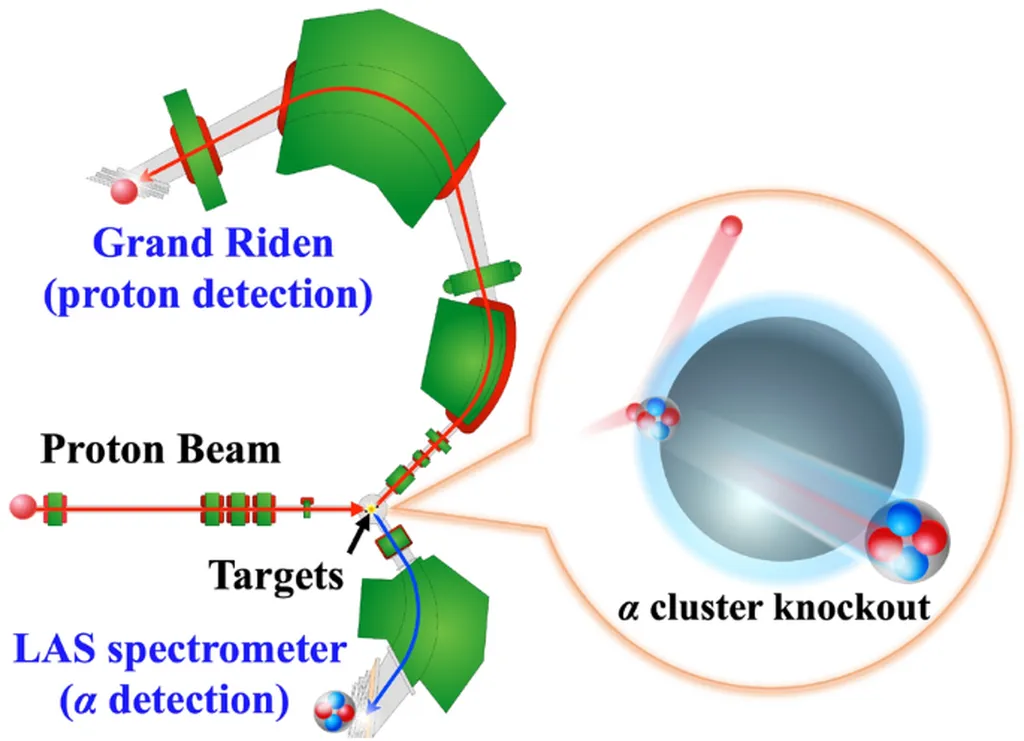
In the realm of nuclear physics and astrophysics, understanding the behavior of nucleons—the particles that make up atomic nuclei—is crucial. Researchers Qi Meng and Chang Xu from the Institute of Modern Physics at the Chinese Academy of Sciences have been delving into this complex world, focusing on how light nuclei behave when embedded in a nuclear medium. Their recent work, published in the journal Physical Review C, sheds light on the formation and dissolution of light clusters, such as deuterons, tritons, helions, and alpha particles, within nuclear matter.
The study employs a microscopic in-medium few-body approach to investigate these phenomena. This method allows the researchers to examine the interactions between a few nucleons within a larger nuclear environment. The researchers found that the weakly bound deuteron, consisting of a proton and a neutron, persists at higher densities compared to the more tightly bound alpha particle, which is made up of two protons and two neutrons. As the density increases, the root mean square radius of the deuteron expands significantly before it eventually dissolves.
The researchers also explored the concept of Mott transitions in nuclear medium. Mott transitions refer to the point at which bound states of particles, such as clusters, dissolve due to the surrounding medium’s influence. They discovered that the Mott density—the density at which a cluster dissolves—of the alpha particle is slightly lower in neutron-rich matter compared to symmetric nuclear matter. This finding could have implications for understanding cluster formation at the nuclear surface and the yields of clusters in intermediate-energy heavy-ion collisions.
The practical applications of this research for the energy sector are primarily indirect but significant. Understanding the behavior of nucleons and clusters within nuclear matter is fundamental to advancing nuclear physics, which in turn supports the development of nuclear energy technologies. Insights into cluster formation and dissolution can contribute to the design of more efficient and safer nuclear reactors, as well as the understanding of nuclear reactions in astrophysical environments, which are relevant to stellar energy production.
The research was published in the journal Physical Review C, a peer-reviewed publication that covers a wide range of topics in nuclear physics. The findings provide valuable constraints for theoretical models and simulations, enhancing our understanding of nuclear matter and its behavior under various conditions. As Qi Meng and Chang Xu continue their work, their contributions are likely to further illuminate the intricate world of nuclear physics, paving the way for advancements in energy technologies and beyond.
This article is based on research available at arXiv.