
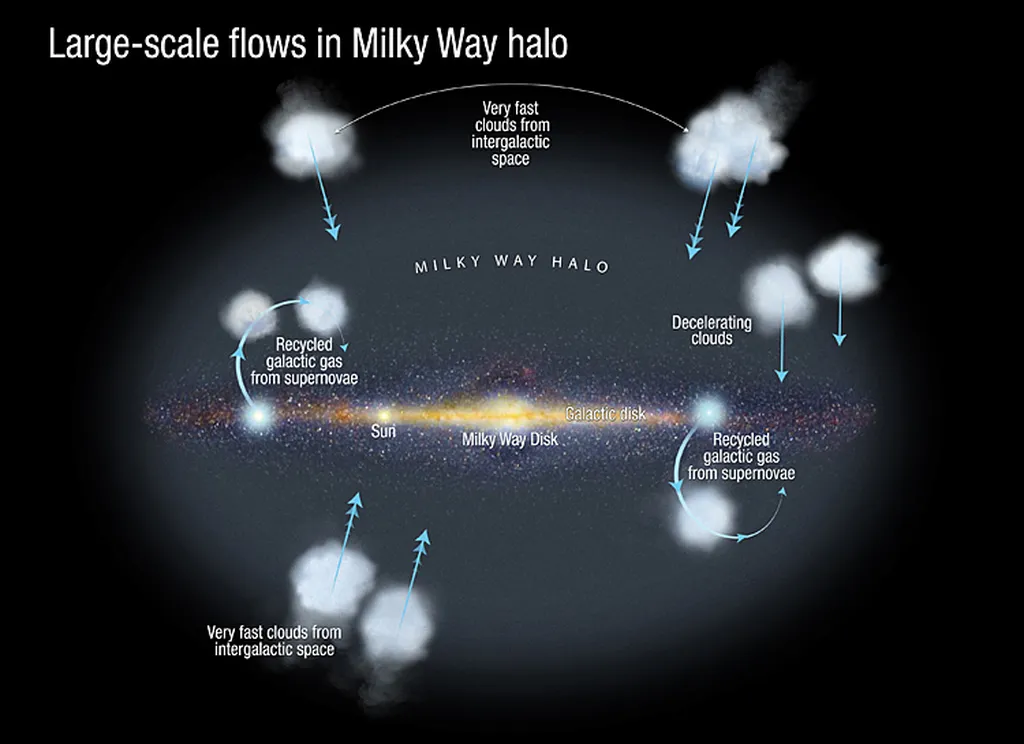
In a recent study, a team of researchers led by Enrico M. Di Teodoro from the University of Virginia explored the molecular clouds within the Milky Way’s galactic outflow. The team, which includes scientists from institutions like the University of Massachusetts and the Commonwealth Scientific and Industrial Research Organisation, used the Atacama Pathfinder EXperiment (APEX) to observe the 12CO(2-1) emission line in 19 fields centered on previously known high-velocity atomic hydrogen (HI) clouds associated with the outflow. Their findings were published in the Astrophysical Journal.
The researchers detected over 200 CO clumps within 16 different HI clouds. These clumps, with typical radii of 1 – 3 parsec, high velocity dispersions of 1 – 6 km/s, and molecular gas masses ranging from a few to several hundred solar masses, are unique in their properties. They sit on the low-mass end of the mass-size relation of regular molecular clouds but are far displaced from the mass (or size) – linewidth relation, indicating that they are more turbulent and show high internal pressures.
Nearly 90% of the clumps are gravitationally unbound, suggesting that these structures are either being disrupted or must be confined by external pressure from the surrounding hot medium. The researchers found that molecular gas is not detected in any of the 6 HI clouds with projected distances over 1 kpc from the Galactic Center, indicating a maximum timescale of approximately 3 Myr for the dissociation of molecular gas within the wind.
The study supports a scenario in which a hot wind entrains cold gas clouds from the disk, driving their progressive transformation from molecular to atomic and ultimately ionized gas through stripping, turbulence, and dissociation. This research provides valuable insights into the processes occurring in the Galactic center and the dynamics of galactic outflows, which can have implications for understanding similar phenomena in other galaxies and the broader universe.
For the energy sector, understanding the dynamics of galactic outflows and the transformation of gas phases can offer insights into the processes that influence the interstellar medium, which is crucial for star formation and the lifecycle of galaxies. This knowledge can help refine models of galactic evolution and the distribution of matter in the universe, which are essential for developing a comprehensive understanding of the cosmos and its energy dynamics.
This article is based on research available at arXiv.