
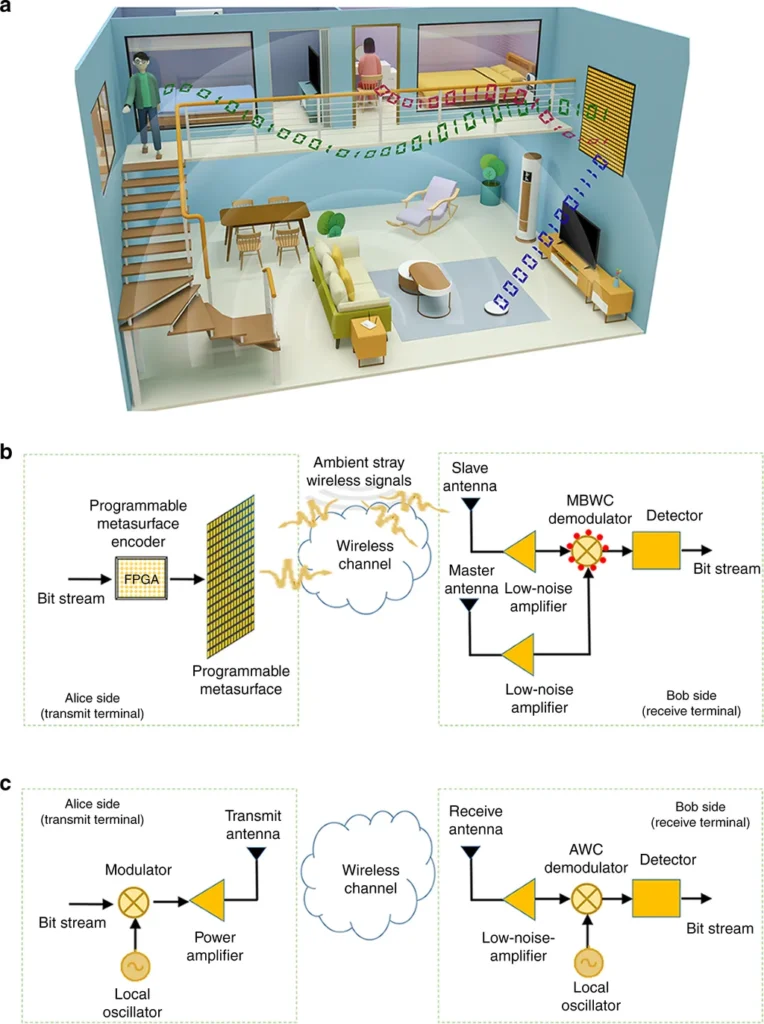
In the realm of energy and technology, a team of researchers from Peking University and the University of Edinburgh have been exploring innovative ways to enhance the capabilities of battery-free Internet of Things (IoT) devices. These researchers, led by Professor Lingyang Song, have been investigating a technology known as meta-backscatter, which aims to extend the communication range of battery-free IoT devices significantly.
Battery-free IoT (BF-IoT) devices are gaining traction due to their low cost and ultra-low power consumption. These devices communicate using a technique called backscatter, where they reflect signals from a nearby source to transmit data. However, traditional backscatter tags have a limited communication range, typically only a few meters, due to the inherent round-trip path loss.
The researchers have proposed a solution to this range limitation through the use of metamaterial tags in a system they term meta-backscatter. Metamaterials are engineered materials that have properties not found in nature, such as the ability to manipulate electromagnetic waves in unusual ways. By incorporating these materials into backscatter tags, the researchers have been able to concentrate the reflected signal power, thereby extending the communication range.
In their paper, published in the journal Nature Communications, the researchers provide a comprehensive overview of backscatter communication, including its development history, working principles, and tag classification. They then delve into the design methodology for both metamaterial tags and their compatible transceivers. The team also presents the implementation of a meta-backscatter system prototype and reports the experimental results, demonstrating the potential of this technology.
The practical applications for the energy sector are significant. Battery-free IoT devices are already being used for monitoring and controlling energy systems, such as smart grids and renewable energy sources. With the extended communication range offered by meta-backscatter, these devices could be deployed in more remote or hard-to-reach locations, improving the overall efficiency and reliability of energy systems. Moreover, the low power consumption and cost-effectiveness of these devices could lead to more widespread adoption, accelerating the transition to a smarter, more sustainable energy future.
While the research highlights the potential of meta-backscatter, it also acknowledges key challenges and outlines avenues for future research. As the technology continues to evolve, it is expected to play an increasingly important role in the energy sector and beyond.
This article is based on research available at arXiv.