
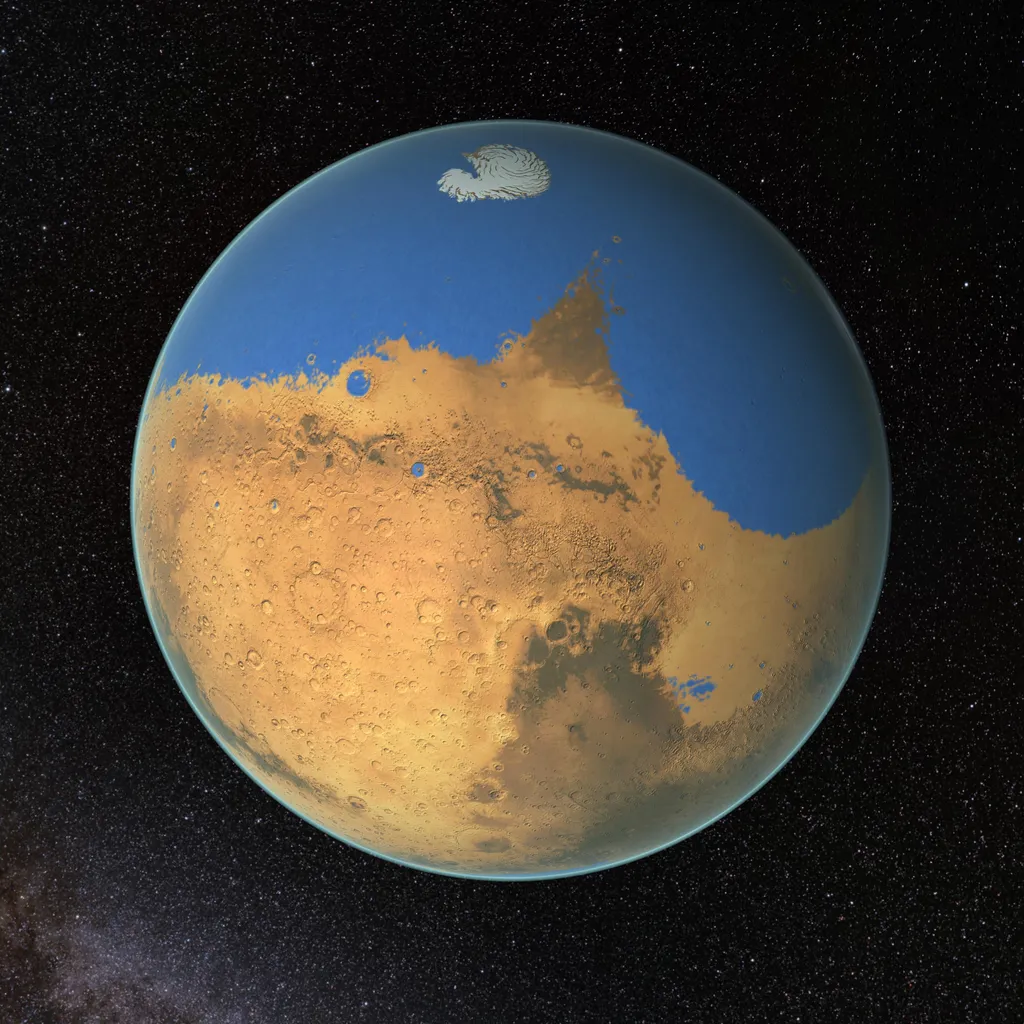
In the realm of energy journalism, a recent study offers intriguing insights into the history of water on Mars, which could have implications for future energy resource exploration in space. The research team, led by Estrid Buhl Naver from the University of Copenhagen, utilized advanced imaging techniques to analyze Martian meteorites, providing a non-destructive method to study extraterrestrial samples.
The study, published in the journal Nature Communications, employed neutron and X-ray computed tomography to map hydrogen distribution within the Martian meteorite NWA 7034 and its pairs. This meteorite is the only known Martian crustal material available on Earth, making it a valuable resource for understanding the Red Planet’s geological history.
The researchers identified hydrogen-rich iron oxyhydroxides within ancient igneous clasts in the meteorite. These hydrous phases form a macroscopic mineralogical water reservoir, suggesting that similar reservoirs may exist on Mars. The alteration assemblages observed in the meteorite closely resemble those found in samples collected by the Perseverance rover in Jezero crater, indicating that such phases may represent a widespread near-surface water reservoir on early Mars.
For the energy sector, this research highlights the potential for in-situ resource utilization (ISRU) on Mars. Understanding the distribution and nature of water reservoirs on the planet is crucial for future missions aiming to extract water for life support and fuel production. Water can be split into hydrogen and oxygen, which are valuable resources for fuel cells and other energy applications.
Moreover, the non-destructive analytical techniques used in this study, such as neutron and X-ray computed tomography, could be adapted for use in space missions. These methods allow for early three-dimensional characterization of sample interiors, enabling scientists to maximize the scientific return from studying extraterrestrial materials without damaging them.
In summary, this research provides valuable insights into the geological history of Mars and the potential for water resources on the planet. For the energy industry, it underscores the importance of developing technologies for ISRU and advancing non-destructive analytical techniques for space exploration. As we look towards the future of energy in space, understanding and utilizing the resources available on other planets will be crucial for sustaining human presence and activities beyond Earth.
This article is based on research available at arXiv.