
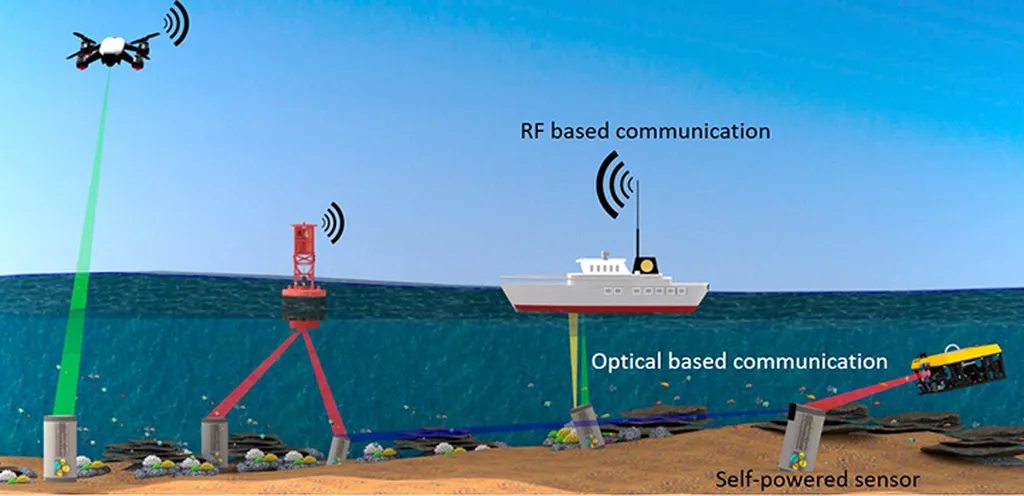
In the realm of underwater monitoring and communication, a trio of researchers from the King Abdullah University of Science and Technology (KAUST) in Saudi Arabia have been exploring innovative solutions to extend the operational life of Internet of Underwater Things (IoUT) devices. Mohamed Afouene Melki, Mohammad Shehab, and Mohamed-Slim Alouini have recently published a study titled “AUV Trajectory Learning for Underwater Acoustic Energy Transfer and Age Minimization” in the IEEE Internet of Things Journal, which presents a novel approach to powering and communicating with underwater devices.
The researchers highlight that conventional IoUT devices, which rely on battery power, have limited lifespans and can pose environmental hazards when disposed of. To address these challenges, they propose a sustainable method that involves an autonomous underwater vehicle (AUV) simultaneously collecting data from IoUT devices and transferring acoustic energy (AET) to them. This approach could potentially enable the devices to operate indefinitely.
The study introduces two deep-reinforcement learning (DRL) algorithms designed to optimize the AUV’s trajectory. The first algorithm offers a high-complexity, high-performance frequency division duplex (FDD) solution, while the second provides a low-complexity, medium-performance time division duplex (TDD) approach. Both algorithms aim to minimize the age of information (AoI), a metric that reflects the time-sensitivity of the data, and maximize data collection fairness using Jain’s fairness index.
The results of the study demonstrate that the proposed FDD and TDD solutions significantly reduce the average AoI and improve the harvested energy and data collection fairness compared to baseline approaches. This research could have practical applications in various sectors of the energy industry, particularly in offshore wind farms, underwater pipelines, and subsea installations, where continuous monitoring and maintenance are crucial. By extending the operational life of IoUT devices and reducing the need for battery replacements, this technology could contribute to more sustainable and efficient underwater energy infrastructure.
In summary, the researchers from KAUST have developed a promising approach to powering and communicating with underwater devices using AUVs and AET. Their work, published in the IEEE Internet of Things Journal, offers valuable insights into the potential of DRL algorithms to optimize underwater data collection and energy transfer, paving the way for more sustainable and efficient underwater energy infrastructure.
This article is based on research available at arXiv.