
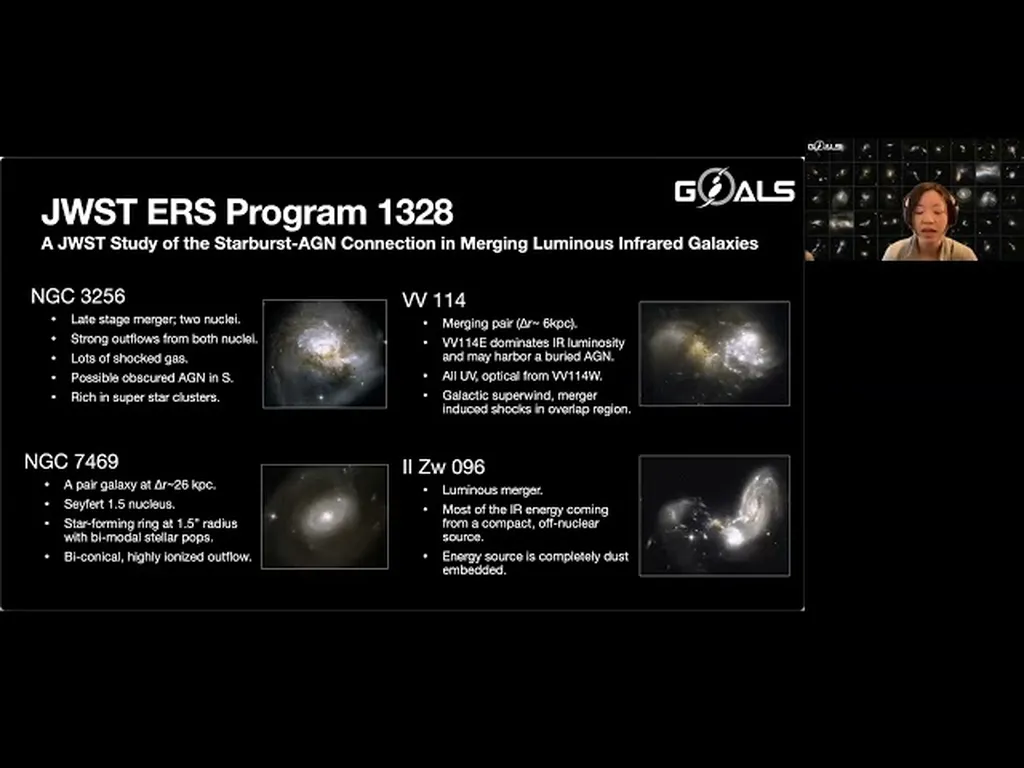
In a recent study, an international team of researchers led by Lulu Zhang from the University of Florida and Chris Packham from the University of Texas at San Antonio has uncovered new insights into the behavior of low-luminosity active galactic nuclei (AGN) using data from the James Webb Space Telescope (JWST). The team, which includes members from various institutions across the globe, has been extending the Galaxy Activity, Torus, and Outflow Survey (GATOS) to better understand the processes occurring in these celestial objects.
The research, published in the Astrophysical Journal Letters, focuses on the infrared spectra of four low-luminosity AGN, specifically examining the nuclear regions with a radius of less than 150 parsecs. The study reveals that these AGN exhibit distinct properties compared to their higher-luminosity counterparts. Notably, the low-luminosity AGN show weaker high-ionization potential lines, such as [Ne V] and [O IV], indicating that fast radiative shocks with velocities of around 100s km/s are the primary source of ionized gas excitation in these regions.
One of the key findings of the study is the presence of a higher fraction of large polycyclic aromatic hydrocarbons (PAHs) with more than 200 carbon atoms in low-luminosity AGN. This suggests that AGN feedback preferentially destroys smaller PAH molecules. The researchers also observed that the molecular hydrogen (H2) transitions in these AGN are not fully thermalized, with slow, jet-driven molecular shocks likely being an additional excitation source.
The study highlights that feedback mechanisms operate in both low- and high-luminosity AGN, but their impact varies with AGN luminosity. The systematic variations in PAH band ratios across AGN demonstrate the differing influence of feedback and suggest that PAH band ratios could serve as diagnostics for distinguishing between kinetic- and radiative-mode AGN feedback.
For the energy sector, understanding the behavior of AGN and their feedback mechanisms can provide insights into the processes that govern the evolution of galaxies and the interstellar medium. This knowledge can contribute to the development of more accurate models of star formation and galaxy evolution, which are crucial for understanding the distribution and availability of resources in the universe. Additionally, the study’s findings on the destruction of smaller PAH molecules by AGN feedback could have implications for the study of organic molecules in space and their potential role in the origins of life.
In summary, this research sheds light on the distinct properties and feedback mechanisms of low-luminosity AGN, offering valuable insights for the energy sector and the broader field of astrophysics.
This article is based on research available at arXiv.