
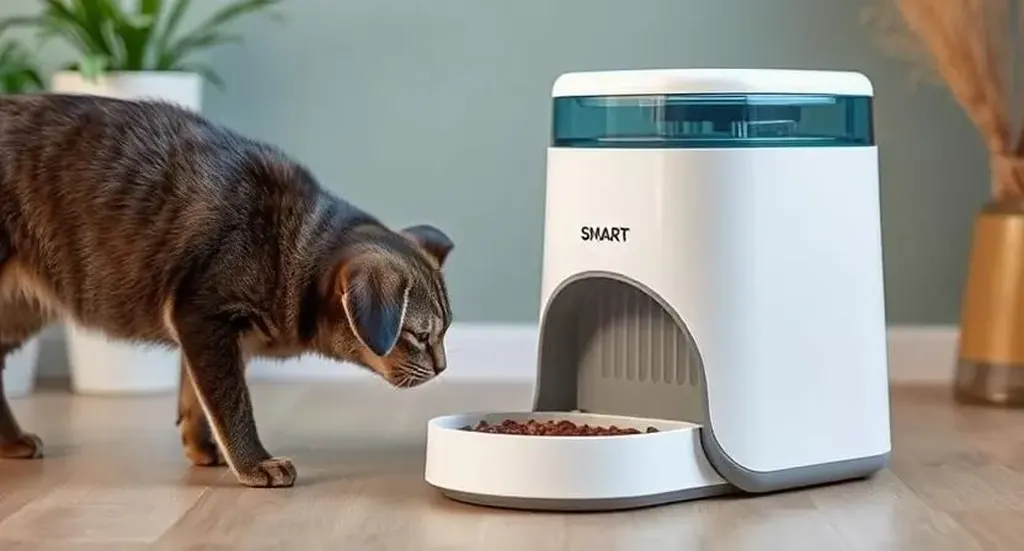
In the realm of smart home technology and pet care, a team of researchers from the University of Dhaka, Bangladesh, has developed a novel solution to address the challenges of maintaining consistent pet feeding schedules. The team, comprising Md. Rakibul Hasan Nishat, S. M. Khalid Bin Zahid, Abdul Hasib, T. M. Mehrab Hasan, Mohammad Arman, and A. S. M. Ahsanul Sarkar Akib, has designed a low-cost, scalable GSM-IoT smart pet feeder that enables remote monitoring and control through cellular communication.
The researchers have created a device that combines an Arduino microcontroller, a SIM800L GSM module for communication, an ultrasonic sensor for real-time food-level assessment, and a servo mechanism for accurate portion dispensing. This innovative system allows pet owners to send feeding commands and receive real-time status updates via a dedicated mobile application developed using MIT App Inventor. The device’s modular, energy-efficient design makes it suitable for a wide range of households, including those with limited resources.
Experimental results demonstrate a 98% SMS command success rate, consistent portion dispensing with ±2.67% variance, and reliable autonomous operation. The researchers highlight that their work pushes forward the field of accessible pet care technology by providing a practical, scalable, and completely internet-independent solution for personalized pet feeding. This development sets a new benchmark for low-cost, GSM-powered automation in smart pet products.
The practical applications of this research extend beyond pet care. The technology could be adapted for use in various sectors of the energy industry, particularly in remote monitoring and control of energy systems. For instance, the GSM-IoT technology could be employed to monitor and manage energy consumption in off-grid or rural areas, where internet connectivity is limited. The energy-efficient design of the device could also contribute to the development of more sustainable and cost-effective energy solutions.
The research was published in the 2023 IEEE 5th International Conference on Telecommunication and IEEE Media Technology (ICSTM), providing a platform for further discussion and development in the field of smart technology and IoT applications.
This article is based on research available at arXiv.