
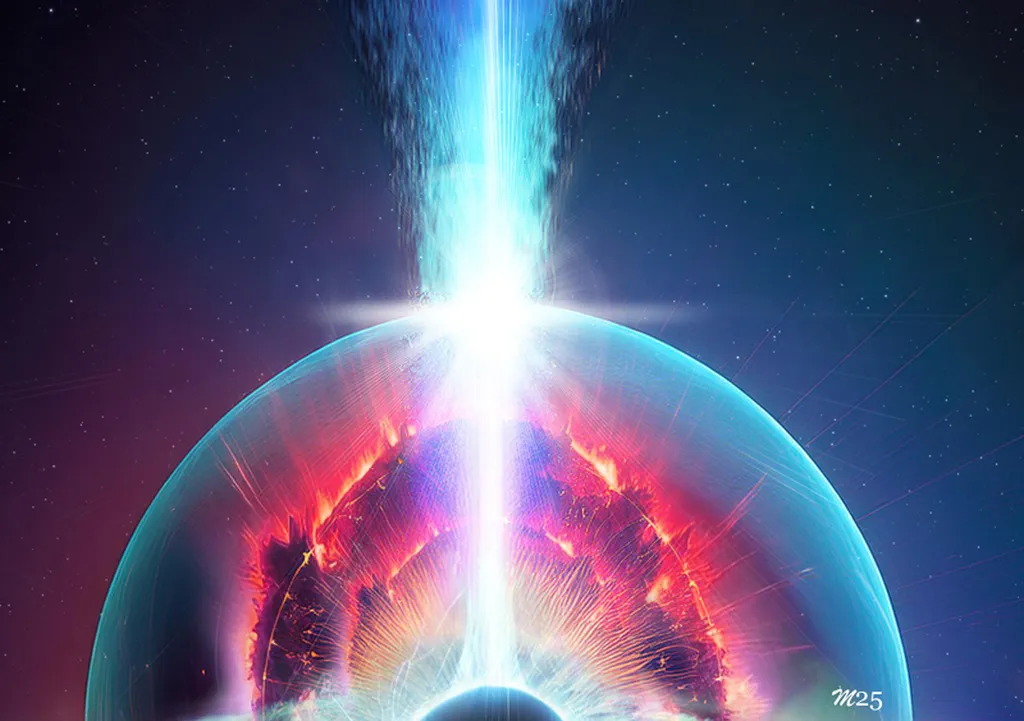
In a recent study published in the Monthly Notices of the Royal Astronomical Society, researchers Umberto Battino, Claudia Lederer-Woods, Claudia Travaglio, Friedrich Konrad Röpke, and Brad Gibson have shed new light on the origins of elements heavier than iron. The team, hailing from institutions like Monash University, the University of Hull, and the Heidelberg Institute for Theoretical Studies, has explored the role of slowly merging white dwarfs in the production of these heavy elements.
The researchers focused on binary systems where two carbon-oxygen white dwarfs merge slowly. As these stellar remnants approach the Chandrasekhar mass during the merger, a series of nuclear reactions occur. The study highlights the activation of the neutron source reaction involving 22Ne and α-particles, which are themselves produced by the burning of carbon-rich material accreted from the secondary white dwarf. This process leads to a neutron capture abundance distribution that resembles a weak s-process, peaking at zirconium, which is overproduced by a factor of 30 compared to solar abundances.
The mass of the external layers enriched in first-peak s-process elements is found to be highly dependent on the rate of the 12C+12C reaction, ranging between 0.05 solar masses and approximately 0.1 solar masses. The researchers propose that if these merging white dwarfs explode via a delayed detonation mechanism, they can efficiently produce the lightest p-process isotopes through γ-induced reactions. Alternatively, if the explosion occurs as a pure deflagration, the unburned external layers, highly enriched in first peak s-process elements, could be ejected.
This study suggests that slow white dwarf mergers in binary systems may be a significant new source for elements heavier than iron. The findings contribute to our understanding of nucleosynthesis and the astrophysical origins of heavy elements, potentially offering new insights into the chemical evolution of galaxies and the solar system. For the energy sector, this research underscores the importance of understanding stellar processes that produce heavy elements, which are crucial for various applications, including nuclear energy and advanced materials.
This article is based on research available at arXiv.