
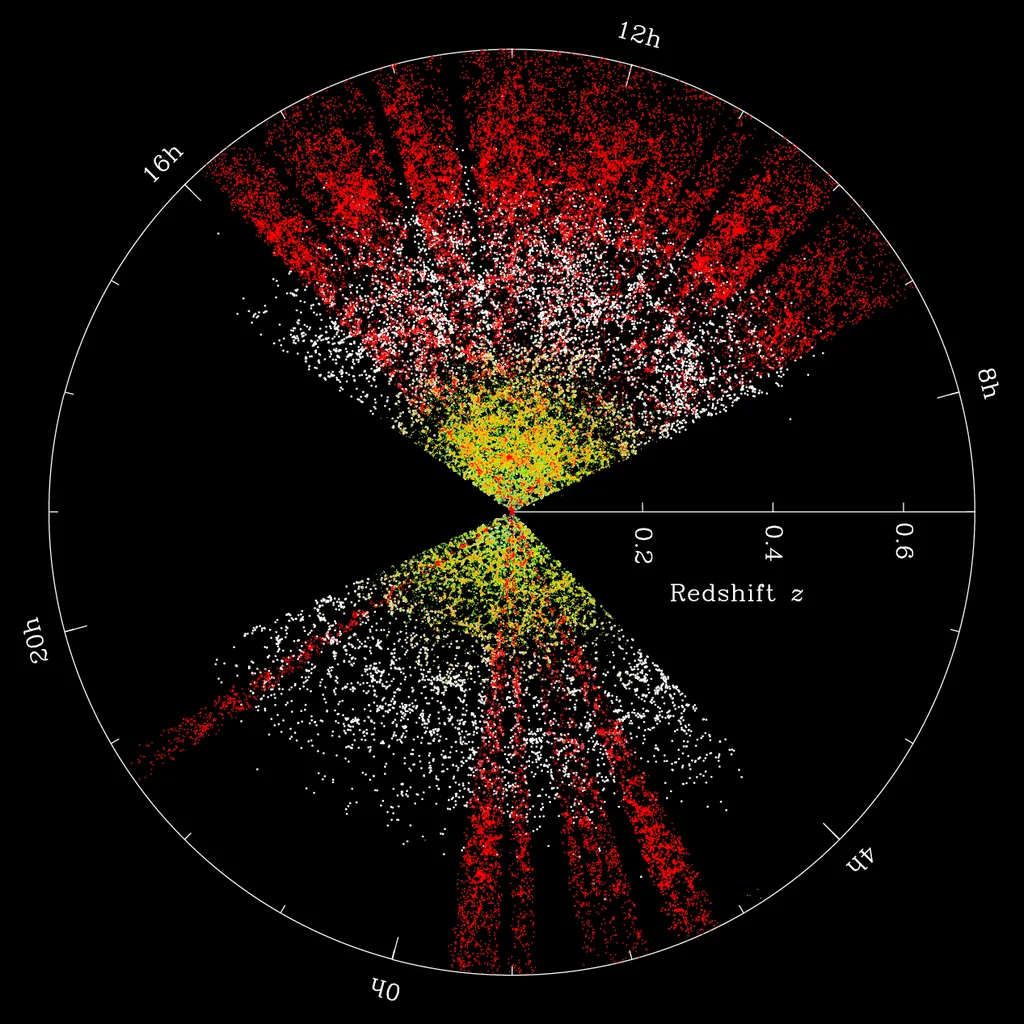
Researchers Sauraj Bharti and Jasjeet Singh Bagla from the Inter-University Centre for Astronomy and Astrophysics (IUCAA) in Pune, India, have developed a novel approach to create mock catalogs that combine optical and atomic hydrogen (HI) data. These catalogs are designed to aid upcoming radio surveys that aim to detect HI emissions from galaxies, providing valuable insights into galaxy evolution and the role of HI in star formation.
Atomic hydrogen is a crucial component in the universe’s baryon cycle, playing a significant role in star formation. The redshifted 21 cm line emission from galaxies serves as a key tracer for studying HI gas dynamics in the interstellar and circumgalactic medium. However, direct detections of HI are currently limited to a redshift of z ≤ 0.4 due to the weak nature of the 21 cm emission line. Ongoing and upcoming large radio surveys, such as MIGHTEE-HI, LADUMA with MeerKAT, and WALLABY with ASKAP, aim to detect HI emissions up to z > 1 with unprecedented sensitivity.
Bharti and Bagla’s research presents a method for creating joint optical-HI mock catalogs for these upcoming surveys. By incorporating optical properties along with HI data, these mock catalogs serve as a powerful tool for predicting survey outcomes and benchmarking expected HI science. The researchers demonstrate the use of these joint catalogs through a case study, showing how stacking observations can help predict the average HI mass in galaxies below the threshold for direct detection. This approach combines stacking observations with the number of direct detections to constrain the HI mass function, particularly in regimes where direct detections are scarce, such as the farther edges of HI surveys.
The researchers suggest that this intermediate step can be used to set priors for the full determination of the HI mass function. This work was published in the Monthly Notices of the Royal Astronomical Society.
For the energy sector, understanding the distribution and dynamics of HI gas in galaxies can provide insights into the evolution of galaxies and the processes that govern star formation. This knowledge can inform models of galaxy evolution and help refine our understanding of the universe’s energy budget. Additionally, the techniques developed for these radio surveys can be applied to other areas of astrophysics and cosmology, potentially leading to new discoveries and a deeper understanding of the universe’s energy dynamics.
This article is based on research available at arXiv.