
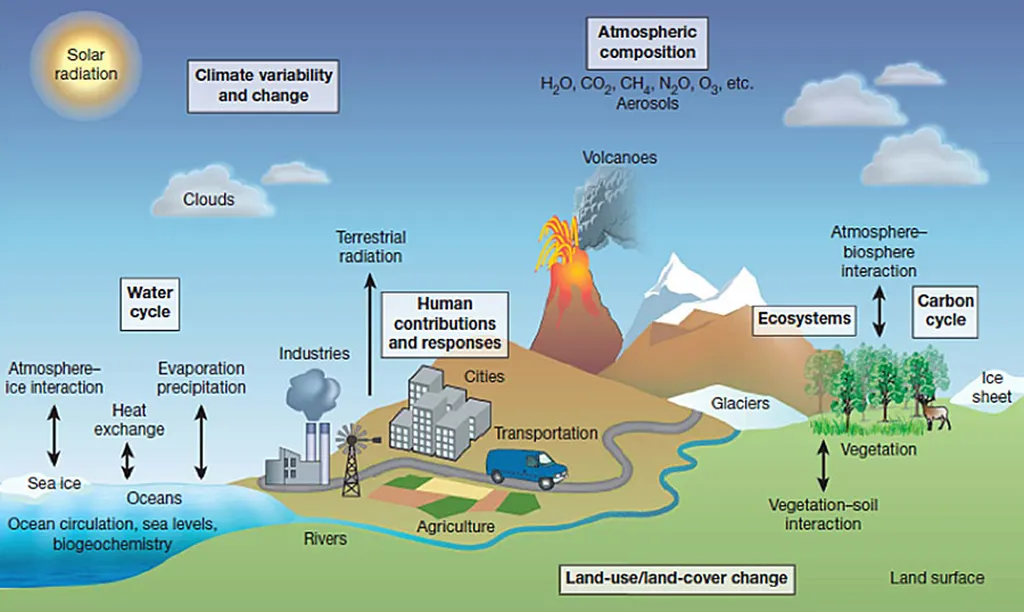
In the realm of energy journalism, a recent study has emerged that bridges the gap between climate science and economics, offering a novel approach to estimating the costs of greenhouse gas emissions. The research, led by Brian P. Hanley and his team, including Pieter Tans, Edward A. G. Schuur, Geoffrey Gardiner, and Adam Smith, all affiliated with the National Oceanic and Atmospheric Administration (NOAA), introduces a new model called OPTiMEM (Ocean-Heat-Content Physics and Time Macro Economic Model) system.
The study, published in the journal “Nature Climate Change,” addresses the persistent rise in global CO2 emissions despite decades of international efforts to curb them. The researchers developed OPTiMEM to better understand the economic impacts of climate change by linking NOAA’s damage estimates to climate models. The model combines a carbon consumption framework with a physics-based climate model to simulate how burning fossil fuels affects global temperatures and ocean heat content.
OPTiMEM uses the latest greenhouse gas equations and production models for CO2, CH4, N2O, and halogenated gases. It estimates how quickly carbon can be burned and how much coal, oil, and natural gas are reasonably available. By simulating the burning of carbon and modeling the Earth’s heating process, the researchers validated each step of the model against known data on carbon consumption, CO2 levels, temperature, and ocean heat content. This approach allows for a physics-founded projection of climate-related costs.
For the energy sector, this research offers practical applications. By providing a more accurate estimation of the economic impacts of greenhouse gas emissions, OPTiMEM can help energy companies and policymakers make informed decisions about investment in clean energy technologies and carbon reduction strategies. The model can also assist in assessing the long-term costs and benefits of different energy portfolios, ultimately supporting the transition to a low-carbon economy.
In summary, the OPTiMEM system developed by Hanley and his team at NOAA represents a significant advancement in linking climate science with economic modeling. This innovative approach offers valuable insights for the energy industry, aiding in the development of strategies to mitigate climate change and adapt to its impacts.
This article is based on research available at arXiv.