
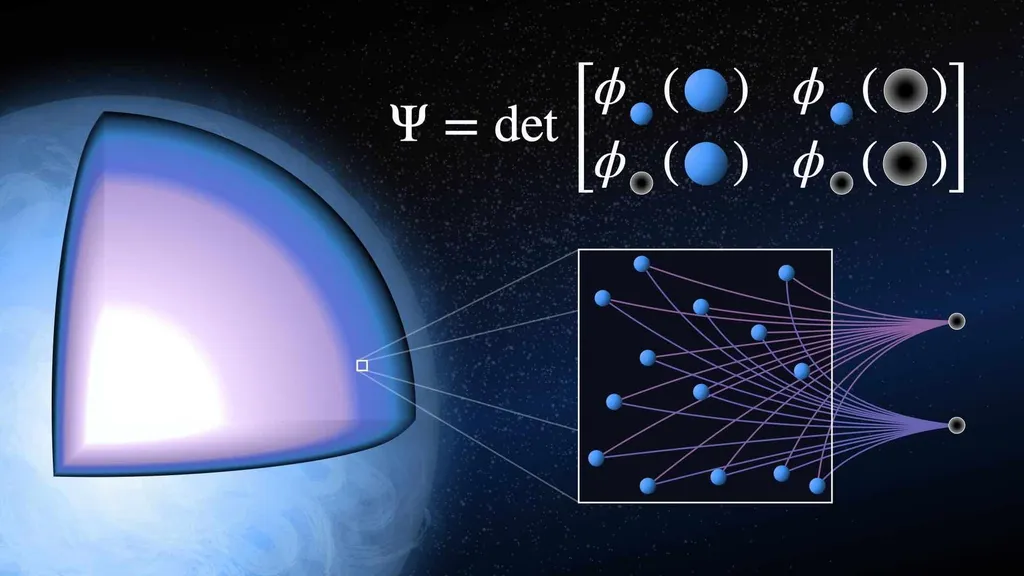
In the realm of astrophysics and nuclear physics, understanding the properties of neutron stars is crucial for advancing our knowledge of the universe and its fundamental forces. Researchers Vishal Parmar and Ignazio Bombaci, affiliated with the University of Pisa in Italy, have delved into the complex structure of neutron star crusts, aiming to shed light on their properties and implications.
Parmar and Bombaci employed a sophisticated Bayesian analysis within a relativistic mean-field (RMF) model to study the neutron star crust. This approach allows for a unified description of dense matter, considering both the outer and inner crusts, as well as the core. The analysis was constrained by nuclear experimental data, chiral effective field theory, and multimessenger neutron-star observations, providing a robust framework for their study.
The researchers focused on extracting key crustal observables, such as the crust-core transition density and pressure, crust thickness, crust mass, and the fractional crustal moment of inertia. They found that the transition density is primarily influenced by the symmetry-energy slope and curvature at sub-saturation densities. The transition pressure, on the other hand, plays a pivotal role in determining the overall properties of the crust. Notably, the inner-crust equation of state is governed by a collective interplay of isovector nuclear-matter properties, rather than being dependent on a single parameter.
One of the significant findings of this study is the impact of using matched crust-core constructions versus fully unified treatments. The researchers demonstrated that matched constructions can introduce systematic differences in the predicted properties of neutron stars when compared to unified treatments. This insight is crucial for refining theoretical models and improving our understanding of neutron star structure.
The practical applications of this research for the energy sector are indirect but noteworthy. Understanding the fundamental properties of neutron stars and their crusts can contribute to the development of advanced materials and technologies that mimic or utilize similar extreme conditions. For instance, insights into the behavior of matter under extreme densities and pressures can inform the design of fusion reactors or the development of materials that can withstand harsh environments.
This research was published in the journal Physical Review C, a prestigious publication in the field of nuclear physics. The study represents a significant step forward in the quest to unravel the mysteries of neutron stars and their implications for both astrophysics and energy research.
This article is based on research available at arXiv.