
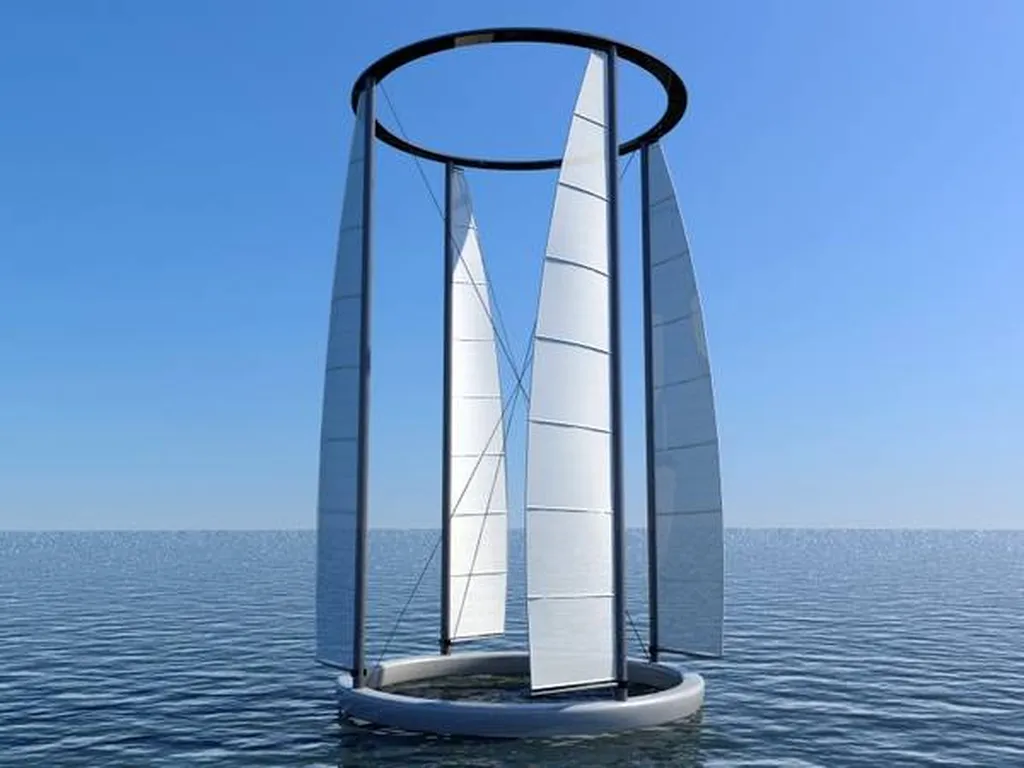
Researchers from the Politecnico di Milano, including Alessandro Fontanella, Kristjan Milic, Alan Facchinetti, Sara Muggiasca, and Marco Belloli, have developed a novel approach to study the complex interactions between floating wind turbines. Their work, published in the journal Renewable Energy, focuses on the wake effects that occur when one turbine operates in the disturbed airflow of another, a common scenario in wind farms.
The team’s research addresses a significant gap in current experimental studies, which often overlook the dynamic interplay between wind turbine wakes and the motion of floating platforms. To tackle this, they introduced a hardware-in-the-loop (HIL) wind-tunnel methodology. This approach combines physical wind-tunnel testing of scaled wind turbine rotors with a real-time numerical model that simulates platform motion, mooring lines, and hydrodynamic forces.
In their experiments, conducted under low-turbulence conditions, the researchers found that a downstream turbine experienced reduced average thrust and platform deflections due to the slower wind speeds in the wake of the upstream turbine. However, the downstream turbine also encountered enhanced low-frequency platform motions caused by the increased turbulent energy in the wake. These findings highlight the complex and often counterintuitive effects of wake interactions on floating wind turbines.
The practical implications of this research are significant for the energy industry. The HIL framework developed by the team provides a controlled and accurate way to study wake-induced excitation mechanisms, which can inform the design and operation of floating wind farms. Additionally, the methodology supports the validation of numerical models and control strategies, ultimately contributing to the improved performance and reliability of floating wind turbines. As the wind energy sector continues to explore offshore and deep-water sites, understanding and mitigating wake effects will be crucial for maximizing energy output and minimizing structural loads.
This article is based on research available at arXiv.