
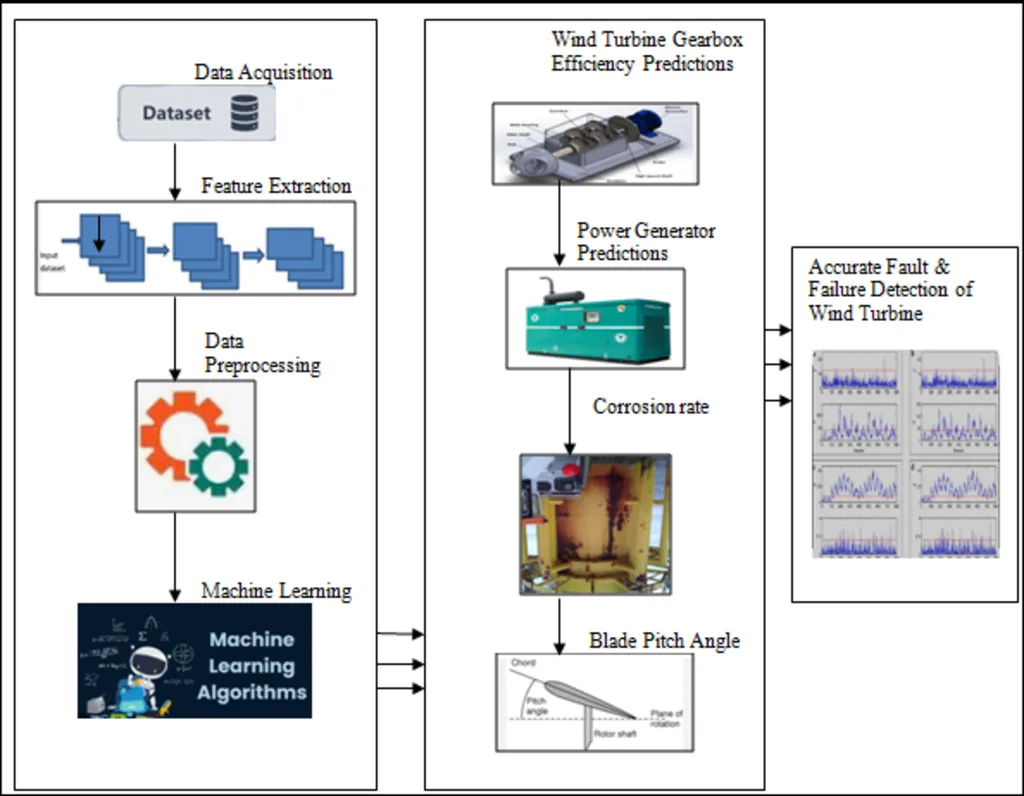
In the pursuit of sustainable energy, wind turbines have become a cornerstone, harnessing the power of wind to generate electricity. However, the intricate nature of these systems makes them susceptible to faults, particularly in their gearboxes, which can compromise their functionality. A team of researchers from the University of Malaya, including Nejad Alagha, Anis Salwa Mohd Khairuddin, Obada Al-Khatib, and Abigail Copiaco, has developed a novel approach to detect faults in wind turbine gearboxes more accurately and efficiently.
The researchers presented a hybrid method that combines Complete Ensemble Empirical Mode Decomposition with Adaptive Noise (CEEMDAN) and a Multiscale Convolutional Neural Network (MSCNN). CEEMDAN is a signal processing technique that decomposes vibration signals from the gearbox into intrinsic mode functions, isolating critical features at different time-frequency scales. These features are then fed into the MSCNN, a type of artificial intelligence model designed to perform deep hierarchical feature extraction and classification.
The proposed method was tested on real-world datasets and achieved an impressive F1 Score of 98.95%, a measure of a test’s accuracy. The researchers found that their approach outperformed existing methods in both detection accuracy and computational speed. This balance of reliability and efficiency makes the framework particularly valuable for the energy sector.
The practical applications of this research are significant. By enabling more accurate and timely fault detection, wind turbine operators can minimize downtime, reduce maintenance costs, and extend the lifespan of their turbines. This, in turn, can contribute to the overall efficiency and sustainability of wind energy generation. The research was published in the IEEE Access journal, a reputable source for scientific and technical research in the field of electrical engineering and related disciplines.
This article is based on research available at arXiv.