
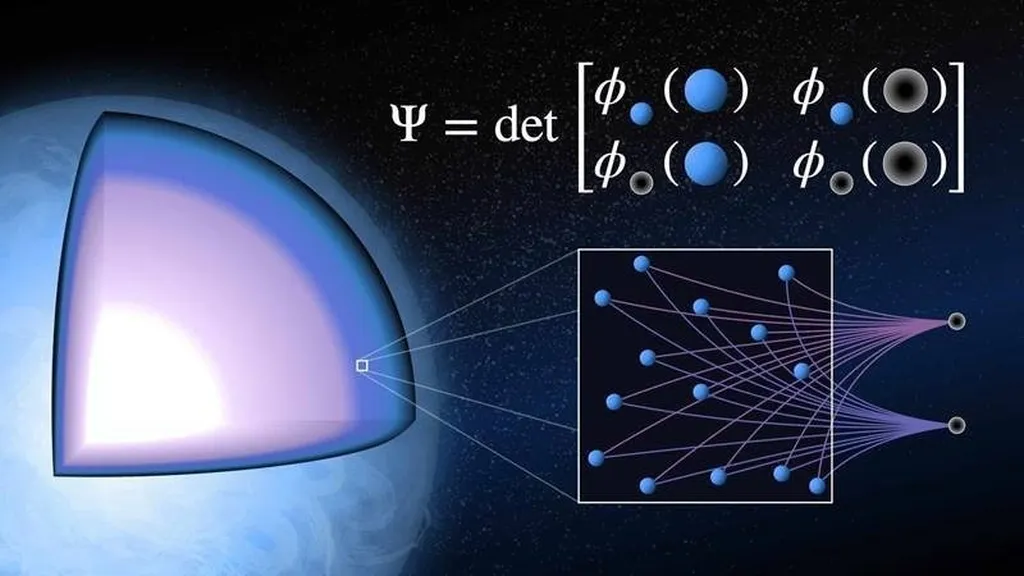
In the realm of astrophysics and nuclear physics, understanding the behavior of matter under extreme conditions is crucial. Researchers from the University of Coimbra in Portugal, including N. K. Patra, Tuhin Malik, Kai Zhou, and Constança Providência, have delved into the complex relationships between neutron star properties and nuclear matter using advanced machine learning techniques. Their work, published in the journal Physical Review C, sheds light on the intricate dynamics of neutron stars and the role of nuclear matter in shaping their characteristics.
Neutron stars, the remnants of massive stars that have collapsed under their own gravity, are composed of extremely dense matter. The equation of state (EOS) of this matter, particularly at densities higher than those found in atomic nuclei, remains uncertain. This uncertainty stems from the complex nuclear interactions and the potential presence of exotic particles like hyperons. The researchers aimed to unravel these complexities by applying symbolic regression, a machine learning algorithm, paired with principal component analysis to datasets derived from Bayesian inference over relativistic mean-field models.
The study focused on two main models: the NL model, which considers only nucleonic degrees of freedom, and the NL-hyp model, which includes hyperons in addition to nucleons. The analysis confirmed a strong correlation between the tidal deformability of a 1.4 solar mass neutron star and the β-equilibrium pressure at twice the nuclear saturation density. This correlation held true even when hyperons were included in the model. Tidal deformability is a measure of how easily a neutron star can be deformed by the gravitational pull of a companion star, and understanding this property is crucial for interpreting gravitational wave data from neutron star mergers.
The researchers also examined the contribution of various nuclear matter properties at saturation to the radius and tidal deformability of neutron stars. They found that isovector properties, which describe the behavior of nuclear matter in response to changes in the proton-to-neutron ratio, have the largest impact, contributing about 90%. Additionally, the study explored the relationship between the proton fraction at different densities and various symmetry energy parameters defined at saturation density. For the hyperon dataset, the effects of the negatively charged hyperon Ξ were taken into account to recover these relationships.
The practical applications of this research for the energy sector are indirect but significant. Understanding the behavior of nuclear matter under extreme conditions can inform the development of advanced nuclear energy technologies. For instance, insights into the properties of dense matter can contribute to the design of more efficient and safer nuclear reactors. Furthermore, the study of neutron stars and their compositions can provide valuable data for the development of nuclear fusion technologies, which aim to replicate the processes that power stars here on Earth.
In conclusion, the research conducted by Patra, Malik, Zhou, and Providência offers a deeper understanding of the complex relationships between neutron star properties and nuclear matter. By leveraging machine learning techniques, they have uncovered robust correlations and the individual impacts of various nuclear matter properties. These findings not only advance our knowledge of astrophysics and nuclear physics but also hold potential for practical applications in the energy sector, particularly in the development of advanced nuclear energy technologies. The research was published in Physical Review C, a leading journal in the field of nuclear physics.
This article is based on research available at arXiv.