
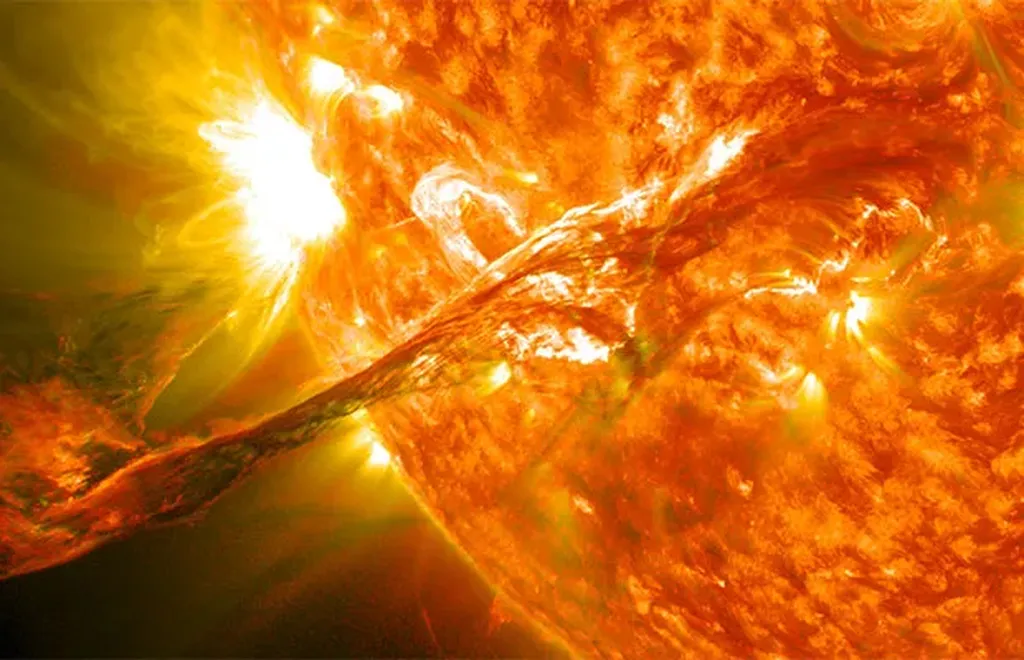
In the realm of space weather and solar research, understanding the behavior of solar phenomena like coronal mass ejections (CMEs) is crucial for predicting their impact on Earth and space infrastructure. A team of researchers from the Indian Institute of Astrophysics, including Jyoti Sheoran, Supratik Banerjee, Vaibhav Pant, Dipankar Banerjee, and M. Saleem Khan, has delved into the turbulent properties of interplanetary CMEs (ICMEs) observed by the Solar Orbiter. Their findings, published in the journal Astronomy & Astrophysics, provide valuable insights into the distinct turbulence regimes within ICMEs compared to the surrounding solar wind.
The researchers analyzed 12 ICMEs observed by the Solar Orbiter between 0.29 and 1.0 astronomical units (AU) from the Sun. They focused on various turbulent properties, such as fluctuation power, spectral indices, break scales, and correlations between magnetic and velocity fluctuations. The study revealed that the ICME sheath, the region preceding the magnetic ejecta, is consistently the most turbulent area at all distances.
One of the key findings is the difference in spectral indices between ICME substructures and the solar wind. The solar wind exhibits inertial-range scaling with either single power laws near f^-3/2 or f^-5/3, or a coexistence of both, influenced by Alfvénicity—the presence of Alfvén waves, which are fluctuations in the magnetic field and plasma velocity. In contrast, ICME substructures consistently show Kolmogorov-like f^-5/3 spectra, indicating a different type of turbulence. The researchers also noted that Alfvénicity is reduced within ICMEs, particularly in the magnetic ejecta, suggesting more balanced Alfvénic fluctuations compared to the solar wind.
The study found that spectral breaks, which indicate a change in the slope of the power spectrum, shift to higher frequencies in ICME regions. The average break frequencies were 0.53 ± 0.35 Hz for the solar wind, 1.87 ± 1.46 Hz for the sheath, and 1.46 ± 1.28 Hz for the magnetic ejecta. These differences reflect variations in underlying microphysical scales and provide a diagnostic tool for identifying ICME boundaries.
For the energy sector, particularly space-based assets like satellites and power grids, understanding the turbulent properties of ICMEs is vital for predicting and mitigating the impacts of space weather events. The distinct turbulence regimes identified in this study can help improve space weather forecasting models, enabling better preparation and protection of critical infrastructure. The findings also support the use of fluctuation power, spectral breaks, and correlations between magnetic and velocity fluctuations as effective diagnostics for identifying ICME boundaries, which is crucial for accurate space weather predictions.
In summary, the research conducted by Sheoran and colleagues sheds light on the complex turbulent properties of ICMEs and their differences from the solar wind. These insights are invaluable for enhancing space weather forecasting and protecting energy infrastructure from the potentially devastating effects of solar storms.
This article is based on research available at arXiv.