
Researchers Rao Uzair Ahmad and Nasir Javed, affiliated with the Department of Chemistry at COMSATS University Islamabad, have recently published a study in the Journal of Nanoparticle Research that explores new methods for synthesizing zinc sulfide (ZnS) quantum dots (QDs). Their work focuses on developing scalable and environmentally friendly techniques for producing these nanomaterials, which have significant potential in the energy sector, particularly in optoelectronic applications.
Zinc sulfide is a non-toxic, wide-bandgap semiconductor known for its excellent optoelectronic properties and environmental benefits. Traditional methods for producing ZnS QDs often involve high temperatures or toxic chemicals, which can be costly and harmful to the environment. Ahmad and Javed aimed to address these issues by comparing two different synthesis routes: hydrothermal and co-precipitation methods. Both methods were conducted under mild conditions and used polyvinylpyrrolidone (PVP) or polyethylene glycol (PEG) as capping agents to control particle size and optical properties.
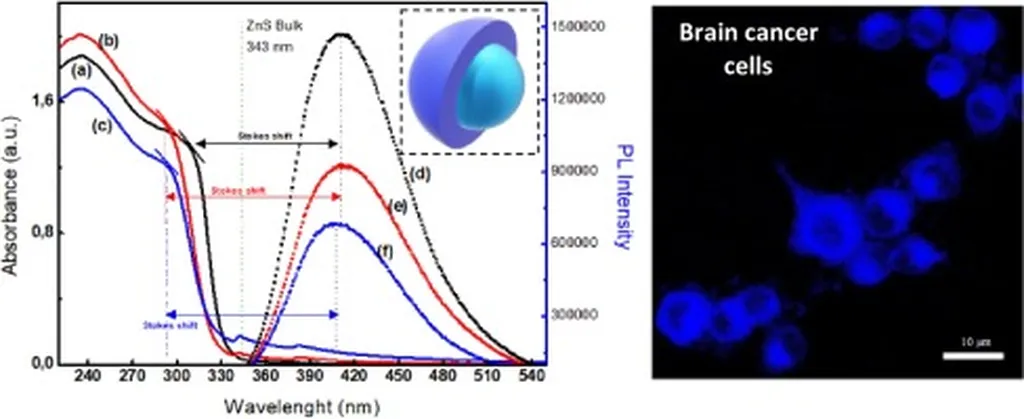
The researchers found that room temperature co-precipitation produced monodisperse ZnS QDs with crystallite sizes as small as 2.03 nm. In contrast, hydrothermal synthesis at higher temperatures yielded larger crystals, exceeding approximately 6 nm. X-ray diffraction confirmed that all samples exhibited a zinc-blende crystal structure, with variations in lattice parameters and peak broadening indicative of nanoscale effects. UV-Visible spectroscopy revealed that the optical band gaps of the QDs could be tuned from 3.60 eV to 3.80 eV, demonstrating strong quantum confinement in smaller particles.
FTIR and DLS analyses confirmed effective surface capping and particle size distribution, with PVP providing greater growth suppression and stability compared to PEG. The study highlights that ambient, polymer-assisted co-precipitation offers a low-toxicity, energy-efficient route for producing high-quality ZnS QDs. This method could be particularly valuable for the energy industry, as it provides a scalable and sustainable approach to manufacturing nanomaterials for optoelectronic applications, such as solar cells, light-emitting diodes (LEDs), and photodetectors.
The practical applications of this research extend beyond the laboratory. By developing a more environmentally friendly and cost-effective method for producing ZnS QDs, Ahmad and Javed’s work could contribute to the advancement of renewable energy technologies. The ability to tune the optical properties of these nanomaterials opens up new possibilities for improving the efficiency and performance of solar cells and other optoelectronic devices, ultimately supporting the transition to a more sustainable energy future.
This article is based on research available at arXiv.