
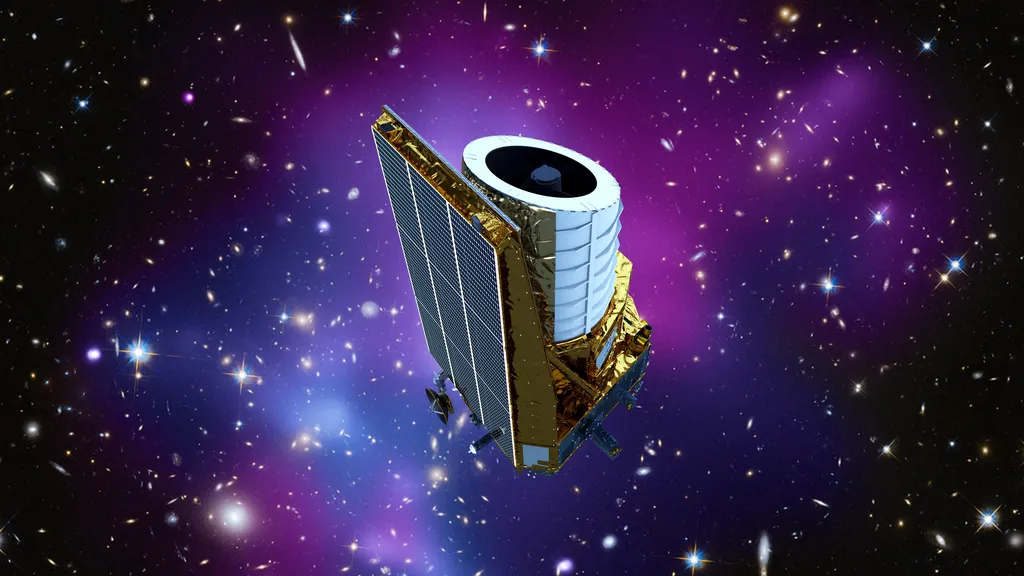
The Euclid Collaboration, a team of researchers affiliated with the Euclid space mission, has been investigating the impact of intrinsic alignments (IA) on the weak lensing signal that the Euclid telescope will observe. Their findings were recently published in a detailed study that aims to improve our understanding of cosmic structures and their evolution.
In their research, the team modeled intrinsic alignments using Euclid’s Flagship simulation, which takes into account both the photometric properties of galaxies and their dark matter host halos. The goal was to compare these simulations with theoretical predictions to better understand the parameters of two widely used IA models: the Non Linear Alignment (NLA) model and the Tidal Alignment and Tidal Torquing (TATT) model.
The researchers measured the amplitude of the simulated IA signal as a function of galaxy magnitude and color within the redshift range of 0.1 to 2.1. They found that both the NLA and TATT models could accurately describe the IA signal in the simulation down to scales of 6 to 7 megaparsecs. For red galaxies, the alignment amplitudes were comparable to those observed in real data, while for blue galaxies, the constraints were consistent with zero alignments in the first redshift bin (0.1 < z < 0.3). However, at higher redshifts, a non-negligible signal was detected, which was consistent with observational constraints. The study also found that the commonly adopted redshift power-law for IA failed to reproduce the simulation alignments above a redshift of 1.1. A significantly better agreement was obtained when a luminosity dependence was included, capturing the intrinsic luminosity evolution with redshift in magnitude-limited surveys. This finding suggests that future IA models should incorporate luminosity dependence to more accurately predict IA contamination in large-scale surveys like those conducted by Euclid. The practical applications of this research for the energy sector are indirect but significant. Understanding the distribution and evolution of cosmic structures, including galaxies and dark matter, can provide insights into the large-scale structure of the universe. This, in turn, can inform models of cosmic inflation and the nature of dark energy, which are fundamental to our understanding of the universe's expansion and the ultimate fate of the cosmos. While these findings may not directly impact energy production or consumption, they contribute to the broader scientific understanding that underpins technological advancements and innovative solutions in various fields, including energy. The research was published in the journal Astronomy & Astrophysics, providing a valuable resource for astronomers and cosmologists working on the Euclid mission and other large-scale cosmic surveys. This article is based on research available at arXiv.