
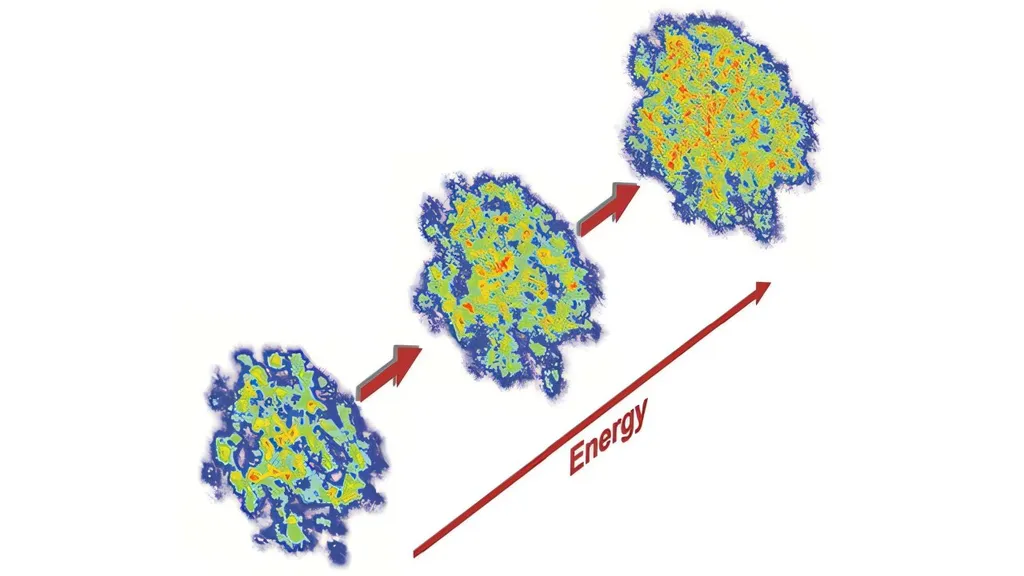
In the realm of high-energy physics, understanding the behavior of nuclear matter under extreme conditions is a critical pursuit. Researchers Hirak Kumar Koley, Subikash Choudhury, and Mitali Mondal, affiliated with the Indian Institute of Technology Indore, have delved into this complex topic through their work on the EPOS4 model. Their findings, published in the journal Physical Review C, offer valuable insights into the dynamics of heavy-ion collisions, which have practical implications for the energy sector, particularly in the development of advanced nuclear technologies.
The study focuses on the Quark-Gluon Plasma (QGP), a state of matter that existed microseconds after the Big Bang and is recreated in high-energy heavy-ion collisions. The recent operation of the Large Hadron Collider (LHC) at a new energy level of 5.36 TeV has prompted the researchers to use the EPOS4 model to predict key global observables in lead-lead (Pb-Pb) collisions. These observables include the charged-particle pseudorapidity density, integrated yields, mean transverse momentum for light-flavor hadrons, and the charged particle nuclear modification factor.
The EPOS4 model successfully captures the strong mass-dependent rise of mean transverse momentum with multiplicity, a signature of collective radial flow. This means that as the number of particles produced in a collision increases, their average transverse momentum also increases, and this effect is more pronounced for heavier particles. The model also predicts a clear suppression of the charged hadron nuclear modification factor, consistent with energy loss mechanisms incorporated into the model. This suppression indicates that particles produced in the collision lose energy as they traverse the hot, dense medium created in the collision.
By comparing these predictions to existing data from collisions at 5.02 TeV, the researchers demonstrate that the EPOS4 model offers a consistent and robust description of heavy-ion dynamics. They project minimal energy evolution for these bulk and hard-probe observables between the two energies. This consistency suggests that the model can be reliably used to predict the behavior of nuclear matter at different energy levels, providing valuable data for the energy sector.
In practical terms, understanding the behavior of nuclear matter under extreme conditions can inform the development of advanced nuclear technologies, such as fusion energy. The insights gained from this research can help in designing and optimizing nuclear reactors, improving safety measures, and enhancing the efficiency of energy production. Furthermore, the robust predictive power of the EPOS4 model can be leveraged to explore new frontiers in nuclear physics and energy research.
In conclusion, the work of Koley, Choudhury, and Mondal represents a significant step forward in our understanding of heavy-ion collisions and the behavior of nuclear matter. Their findings, published in Physical Review C, offer valuable data and insights that can be applied to the energy sector, particularly in the development of advanced nuclear technologies. As research in this field continues, the practical applications of these findings are expected to grow, contributing to a more sustainable and energy-efficient future.
This article is based on research available at arXiv.