
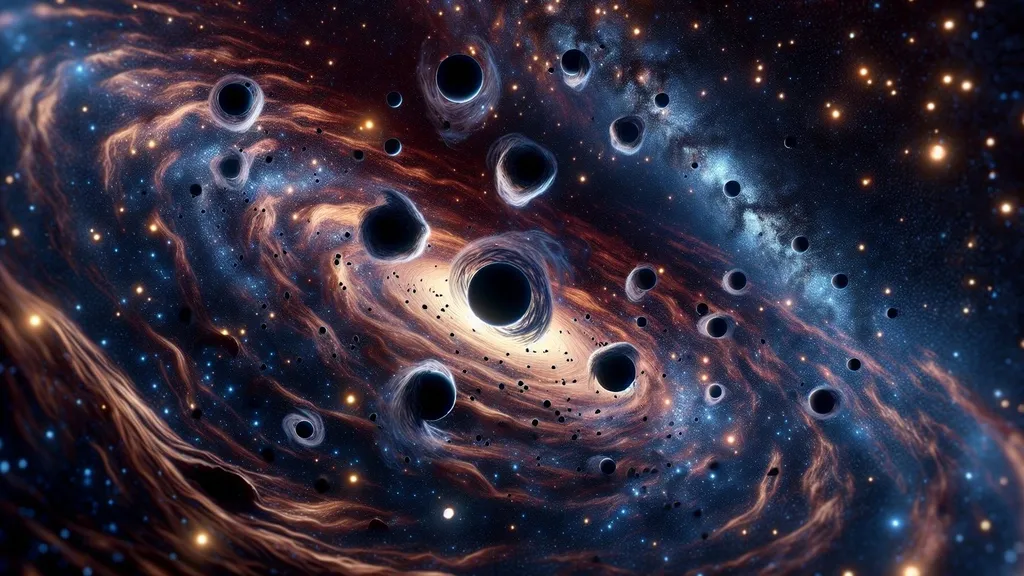
In the realm of astrophysics and cosmology, researchers are continually pushing the boundaries of our understanding of the universe. Among them is Jeremy Mould, a distinguished astronomer from the University of Melbourne, who has been delving into the mysteries of dark matter and its implications for the large-scale structure of the universe.
Mould’s recent research suggests that dark matter, which makes up a significant portion of the universe’s mass, might not be composed of fundamental particles as previously thought. Instead, it could be macroscopic, taking the form of primordial black holes (PBHs) that originated in the early universe. This hypothesis is supported by the high value of the cosmic microwave dipole, a large-scale feature in the cosmic microwave background radiation.
The presence of PBHs would have significant implications for the formation of dark matter halos, the gravitational structures that surround galaxies. Unlike standard cold dark matter (CDM) candidates, PBHs behave as dense, non-relativistic matter from the very beginning of the radiation-dominated era. This allows them to seed gravitational potential wells and begin clustering much earlier than standard CDM. Mould’s research indicates that starting N-body simulations, which model the gravitational interactions of dark matter particles, at redshifts even before matter-radiation equality yields galaxy bulk flow velocities that are systematically larger than those predicted by standard Lambda CDM (LCDM) models.
The early, high-mass concentrations established by PBHs lead to a more rapid and efficient gravitational acceleration of surrounding baryonic and dark matter. This generates larger peculiar velocities that remain coherent over scales of hundreds of megaparsecs. Moreover, a sub-population of PBHs in the 10^-20 to 10^-17 solar mass range would lose a non-negligible fraction of their mass via Hawking radiation over cosmological timescales. This evaporation process converts matter into radiation, introducing a time-varying matter density parameter, Omega_m’, which behaves like a boosted radiation term in the Friedmann equation. This dynamic term acts to reduce the Hubble tension, a discrepancy in the measured expansion rate of the universe.
The research also suggests that PBH mass loss influences fits to the equation of state parameter, w, at low redshift. Mould emphasizes that the naive N-body modelling presented in the research should be further investigated using tried and tested cosmology codes, by introducing mass-losing PBHs and starting the evolution as early as practicable.
This research, published in the Monthly Notices of the Royal Astronomical Society, offers a new perspective on the nature of dark matter and its role in the evolution of the universe. While the practical applications for the energy sector are not immediately apparent, a deeper understanding of the universe’s fundamental components and their interactions could potentially inform our approach to energy generation and utilization, particularly in the context of nuclear fusion and other advanced energy technologies.
As Mould’s research demonstrates, the pursuit of fundamental scientific knowledge can often lead to unexpected and transformative insights, with far-reaching implications for our understanding of the universe and our place within it.
This article is based on research available at arXiv.