
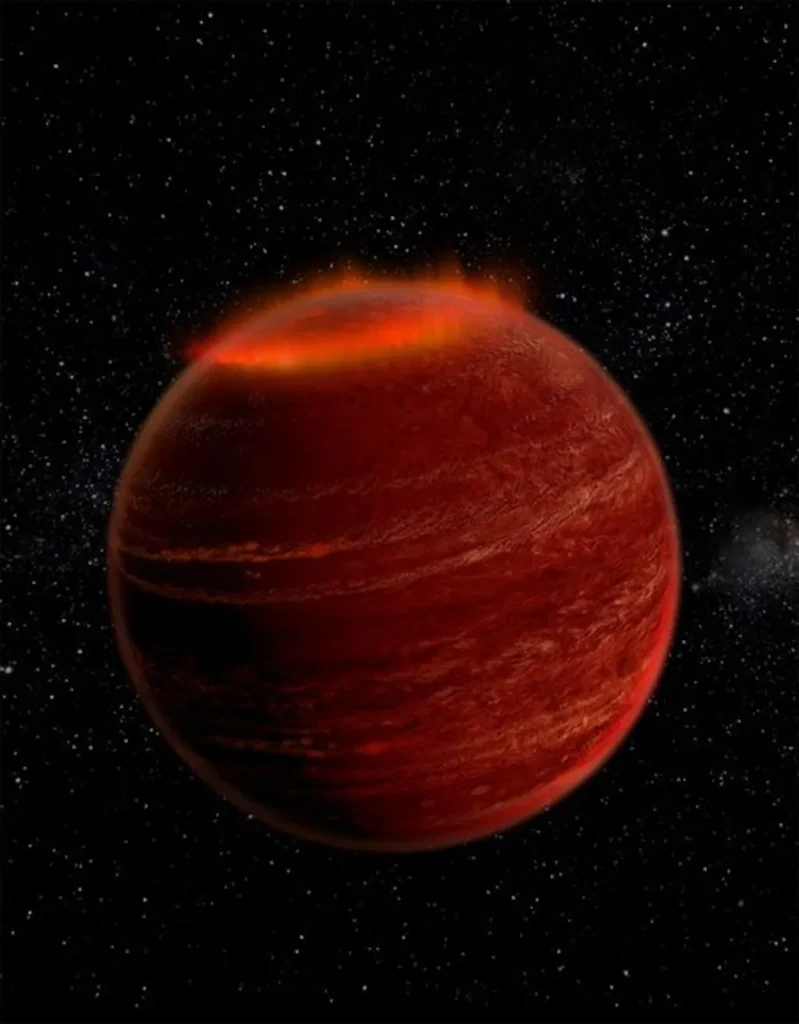
In a recent study, a team of researchers from the University of Texas at Austin, including Anna Zuckerman, J. Sebastian Pineda, David Brain, James Mang, and Caroline Morley, have delved into the intriguing world of brown dwarfs and their auroral emissions. Their work, published in the Astrophysical Journal, aims to understand the unique auroral processes occurring in these celestial bodies, which are neither planets nor stars but something in between.
Brown dwarfs, often referred to as failed stars, have been known to exhibit magnetic activity similar to planets, rather than stars. This was first confirmed over two decades ago with the detection of electron cyclotron maser instability (ECMI) radio emission, indicating the presence of aurorally precipitating electrons. However, despite extensive searches, the corresponding optical, ultraviolet, and infrared auroral emissions expected based on solar system analogs have not been detected. This suggests that the auroral processes in brown dwarfs differ significantly from those in our solar system’s planets.
To bridge this gap in understanding, the researchers developed a Monte Carlo simulation to model the interactions of monoenergetic electron beams with brown dwarf atmospheres. This simulation was validated against previously published results for Jupiter, with the team noting some discrepancies due to updated interaction cross sections. The simulation was then applied across a range of surface gravities and effective temperatures of radio-emitting brown dwarfs.
One of the key findings of this study is that atmospheric column density governs the interaction profiles of electron beams in brown dwarf atmospheres. Based on this, the researchers developed an analytic parameterization of interaction rates. This parameterization was used to calculate total volumetric interaction rates and energy deposition rates for representative electron beam energy spectra. These calculations will aid in predicting the spectra of aurorally emitting brown dwarfs, guiding future observational searches for multi-wavelength auroral features beyond our solar system.
While this research is primarily focused on astrophysics, it has potential implications for the energy sector, particularly in the field of plasma physics and magnetic confinement fusion. Understanding the interactions of electron beams with different types of atmospheres can provide insights into plasma behavior and energy transfer processes. These insights could potentially contribute to the development of more efficient and stable fusion reactors, which are a promising avenue for clean and abundant energy production.
In conclusion, the work of Zuckerman, Pineda, Brain, Mang, and Morley sheds light on the unique auroral processes occurring in brown dwarfs. Their simulations and analytic parameterizations provide a valuable tool for future observations and a deeper understanding of these enigmatic celestial bodies. While the direct applications to the energy sector may be indirect, the underlying physics could offer valuable insights for advancing fusion energy technologies.
This article is based on research available at arXiv.