
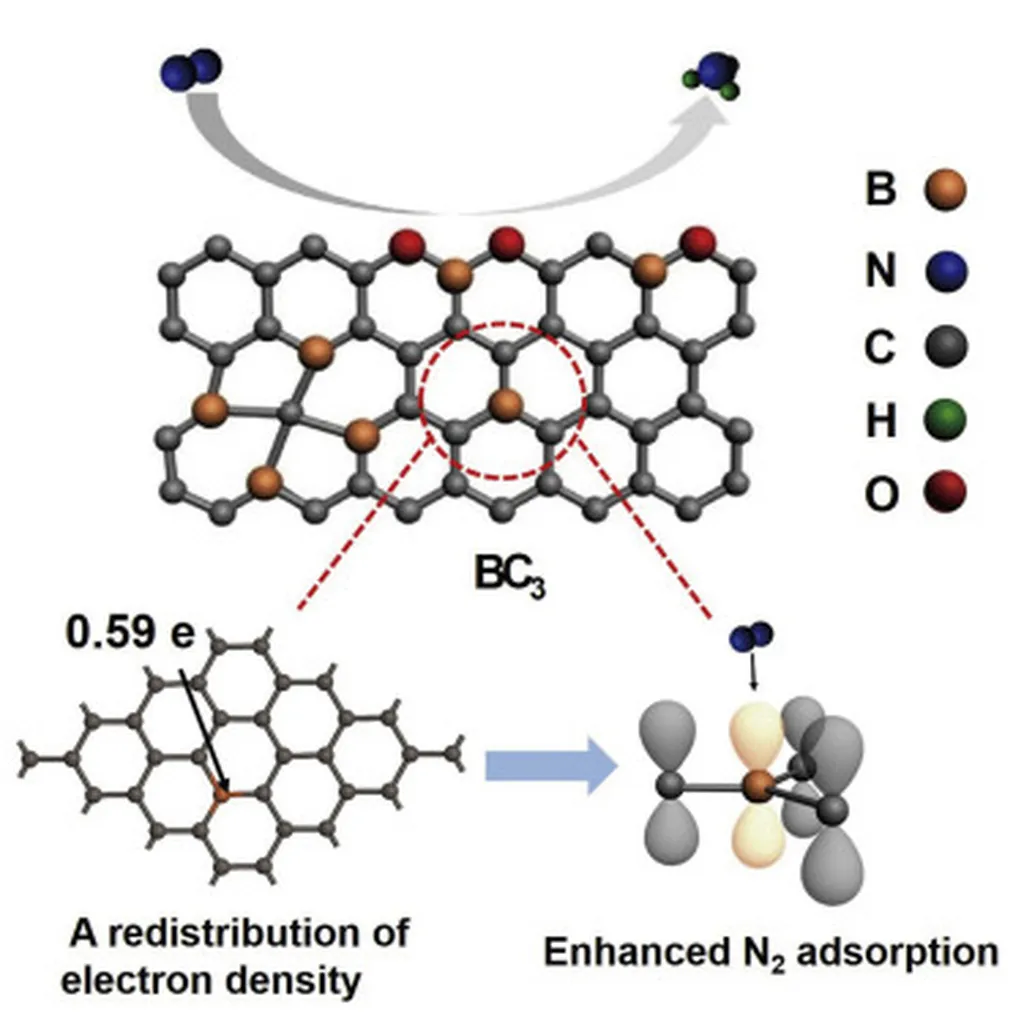
In the realm of energy storage and conversion, researchers are continually exploring innovative materials to enhance performance and efficiency. A recent study conducted by Nikola Veličković, Natalia V. Skorodumova, and Ana S. Dobrota from the University of Belgrade, Serbia, delves into the potential of boron-doped graphene as a metal-anchor, with implications for next-generation batteries and catalytic applications.
The research, published in the journal Carbon, employs density functional theory (DFT) to investigate the interaction between boron-doped graphene and four metals: magnesium (Mg), zinc (Zn), copper (Cu), and platinum (Pt). These metals were selected for their relevance in energy storage (Mg and Zn) and catalysis (Cu and Pt).
The study examines three different boron doping concentrations to understand how the density of dopants influences the binding strength, charge transfer, and electronic structure of the resulting systems. The findings reveal that boron doping significantly enhances graphene’s affinity for metal adsorption. However, the extent and nature of this effect vary depending on the type of metal and the level of doping. For some metals, the interaction is primarily driven by charge transfer, with minimal orbital hybridization.
The researchers also explored the effects of biaxial strain and surface oxidation on the reactivity and stability of boron-doped graphene. Mechanical strain was found to enable fine-tuning of the metal/substrate interaction, offering a way to optimize performance. Surface oxidation, on the other hand, introduces a more pronounced effect by enabling direct interaction between metal atoms and oxygen functional groups. This alters the adsorption geometry and strength, providing another avenue for tailoring the material’s properties.
These insights are valuable for the design of boron-doped graphene materials for energy conversion and storage applications. By understanding and controlling the interaction between graphene and metals, researchers can develop more efficient batteries and catalytic systems, contributing to advancements in the energy sector. The study highlights the potential of boron-doped graphene as a versatile platform for various energy-related applications, paving the way for further research and development in this promising field.
This article is based on research available at arXiv.