
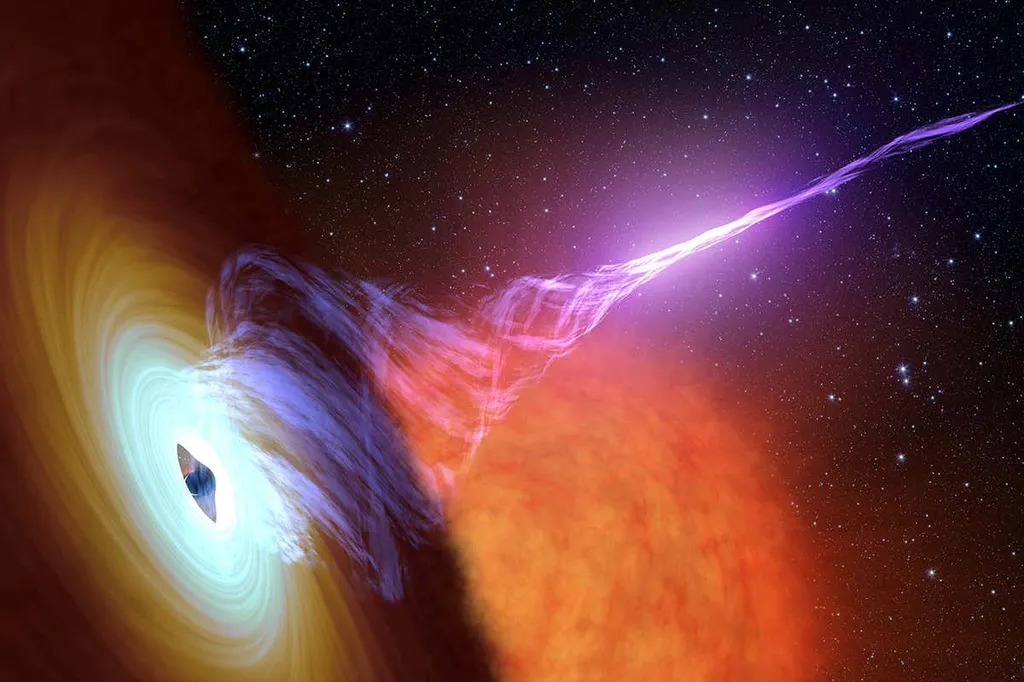
In the quest to understand the origins of cosmic rays, a team of researchers from the University of Oxford, including Nicolas J. Bacon, Alex J. Cooper, Dimitrios Kantzas, James H. Matthews, and Rob Fender, has turned their attention to black hole X-ray binary systems. These systems, which consist of a black hole and a companion star, are known to produce powerful ejections of material during state transitions. The researchers have investigated whether these ejecta could be a potential source of cosmic rays, particularly those with energies up to PeV (peta-electronvolt) levels.
The study, published in the journal Monthly Notices of the Royal Astronomical Society, builds upon recent detections of high-energy gamma rays by the Large High Altitude Air Shower Observatory (LHAASO). The researchers focused on the black hole X-ray binary system MAXI J1820+070, analyzing multi-wavelength observations to determine if efficient particle acceleration could occur within the ejecta. Their calculations suggest that particles could indeed be accelerated to energies of up to approximately 2 x 10^16 μ^(-1/2) electron volts, where μ represents the ratio of particle energy to magnetic energy.
The researchers estimate that the global contribution of such ejecta to the entire Galactic cosmic ray spectrum is around 1%. However, this contribution could rise to about 5% at PeV energies, assuming that roughly equal amounts of energy are contained in non-thermal protons, non-thermal electrons, and magnetic fields. This finding is significant, as it suggests that black hole X-ray binary systems could play a role in the production of the most energetic cosmic rays within our galaxy.
In addition to investigating cosmic ray production, the researchers also calculated the associated gamma-ray and neutrino spectra of the MAXI J1820+070 ejecta. These calculations were aimed at exploring new detection methods using the upcoming Cherenkov Telescope Array Observatory (CTAO). The results provide strong constraints on the initial size of the ejecta, suggesting that it is of the order of 10^7 Schwarzschild radii, or approximately 10^-5 parsecs, assuming a period of adiabatic expansion.
For the energy industry, this research offers insights into the origins of cosmic rays, which can impact space-based infrastructure and technologies. Understanding the sources of these high-energy particles can help in developing better shielding and protection measures for satellites, space stations, and other space-based assets. Furthermore, the study of particle acceleration mechanisms in astrophysical environments can contribute to advancements in plasma physics and high-energy density science, which have applications in fusion energy research and other areas of energy technology.
This article is based on research available at arXiv.