
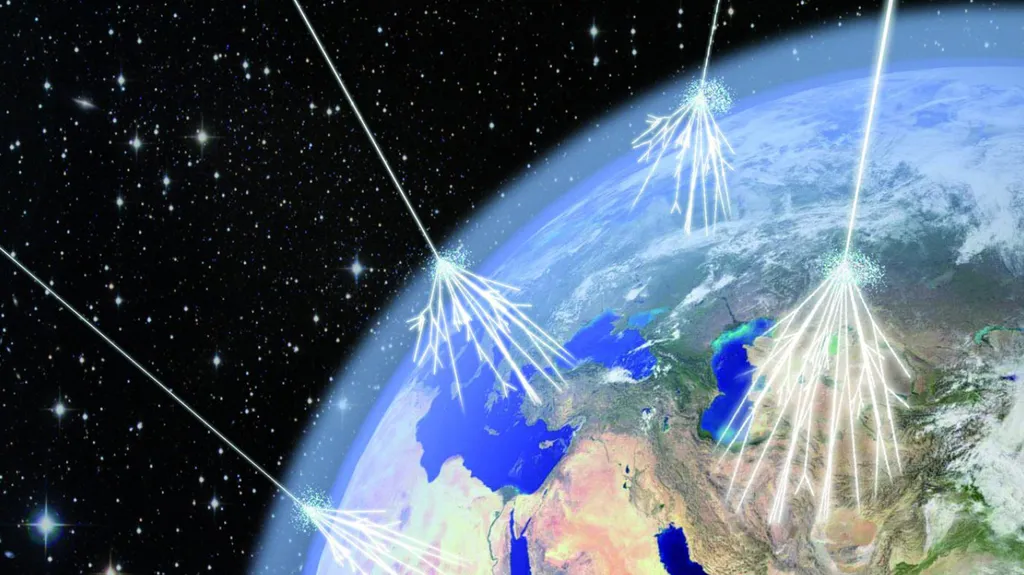
In the realm of cosmic-ray research, two names stand out: Ke Fang, an assistant professor at the University of Wisconsin-Madison, and Francis Halzen, a renowned physicist and principal investigator for the IceCube Neutrino Observatory, also at UW-Madison. Their latest study, published in the journal Physical Review Letters, delves into the mysteries of cosmic rays and their origins, with potential implications for our understanding of high-energy phenomena and even the energy sector.
Cosmic rays are high-energy particles that permeate space, and their spectrum—a graph of their energy distribution—reveals a peculiar feature known as the “knee.” This is a point at around 4 PeV (peta-electronvolts) where the spectrum suddenly steepens. Scientists have long debated whether this knee is a global feature, present throughout the Milky Way, or a local phenomenon, caused by nearby sources.
Fang and Halzen’s research explores these two scenarios through simulations of cosmic-ray propagation in the Galactic magnetic field and interstellar medium. They find that the global and local interpretations correspond to different regimes of the birth rate of PeV proton accelerators, also known as PeVatrons. The local scenario, they argue, would be best explained by sources located roughly 1 kiloparsec (about 3,260 light-years) away, with ages ranging from 0.1 to 1 million years. One particularly promising candidate for such a source is the Cygnus Cocoon, a massive star-forming region in our galaxy.
The practical applications of this research for the energy sector might not be immediately apparent, but understanding cosmic rays and their sources can have significant implications. For instance, cosmic rays can interfere with electrical systems and pose challenges for space-based solar power systems or other high-altitude energy technologies. Moreover, the study of high-energy phenomena can inspire innovations in energy production, such as advancements in nuclear fusion research, which seeks to replicate the processes powering the stars.
In essence, Fang and Halzen’s work sheds new light on the origins of cosmic rays and the nature of the cosmic-ray knee. While the direct applications to the energy industry may be indirect, the pursuit of such fundamental scientific questions can often lead to unexpected technological advancements and a deeper understanding of the universe we live in.
Source: Physical Review Letters, “The Cosmic-ray Knee as a Local Signature of Nearby PeVatrons” by Ke Fang and Francis Halzen.
This article is based on research available at arXiv.