
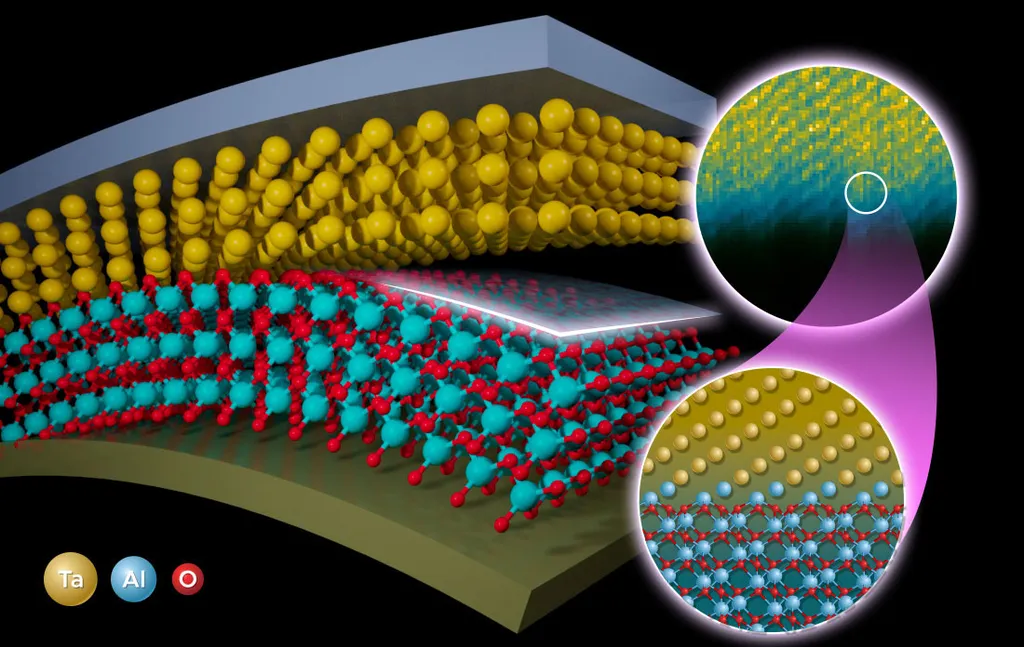
Researchers from the U.S. Department of Energy’s Fermi National Accelerator Laboratory, Northwestern University, and the University of Wisconsin-Madison have published a study in the journal “Applied Physics Letters” that delves into the atomic-scale behavior of oxygen in niobium (Nb) and tantalum (Ta)-encapsulated Nb thin films, which are crucial components in superconducting qubits.
The team, led by Jaeyel Lee and including experts from various institutions, utilized advanced techniques such as atom-probe tomography (APT) and transmission electron microscopy (TEM) to investigate the distribution and segregation of oxygen at grain boundaries (GBs) in these thin films. Their findings reveal that oxygen tends to segregate at the grain boundaries, with higher concentrations within the Nb grains leading to greater segregation levels at the boundaries. This observation underscores the importance of controlling oxygen impurities during the film deposition and fabrication processes to minimize oxygen segregation at grain boundaries.
The researchers found that the enrichment factor, which measures the ratio of oxygen concentration at grain boundaries to that within the grains, is approximately 2.7 for Nb films. Interestingly, Ta-capped Nb thin films showed slightly reduced Nb grain boundary enrichment factors of 2.3, while the grain boundaries in the Ta capping layer itself exhibited higher enrichment factors of 3.0. This suggests that the Ta capping layer may trap oxygen, thereby influencing its diffusion and segregation at the grain boundaries in the underlying Nb thin films.
Furthermore, the study revealed that increases in oxygen concentration in both the Nb grains and grain boundaries correlate with a suppression in the critical temperature for superconductivity (Tc). This finding provides atomic-scale insights into a potential mechanism contributing to decoherence in superconducting qubits, which is a critical factor affecting their performance and reliability.
The practical implications of this research are significant for the energy sector, particularly in the development of superconducting technologies. By understanding and controlling oxygen segregation at grain boundaries, engineers can enhance the performance and durability of superconducting materials used in various applications, including energy transmission and storage systems. This research paves the way for more efficient and reliable superconducting devices, ultimately contributing to advancements in the energy industry.
This article is based on research available at arXiv.