
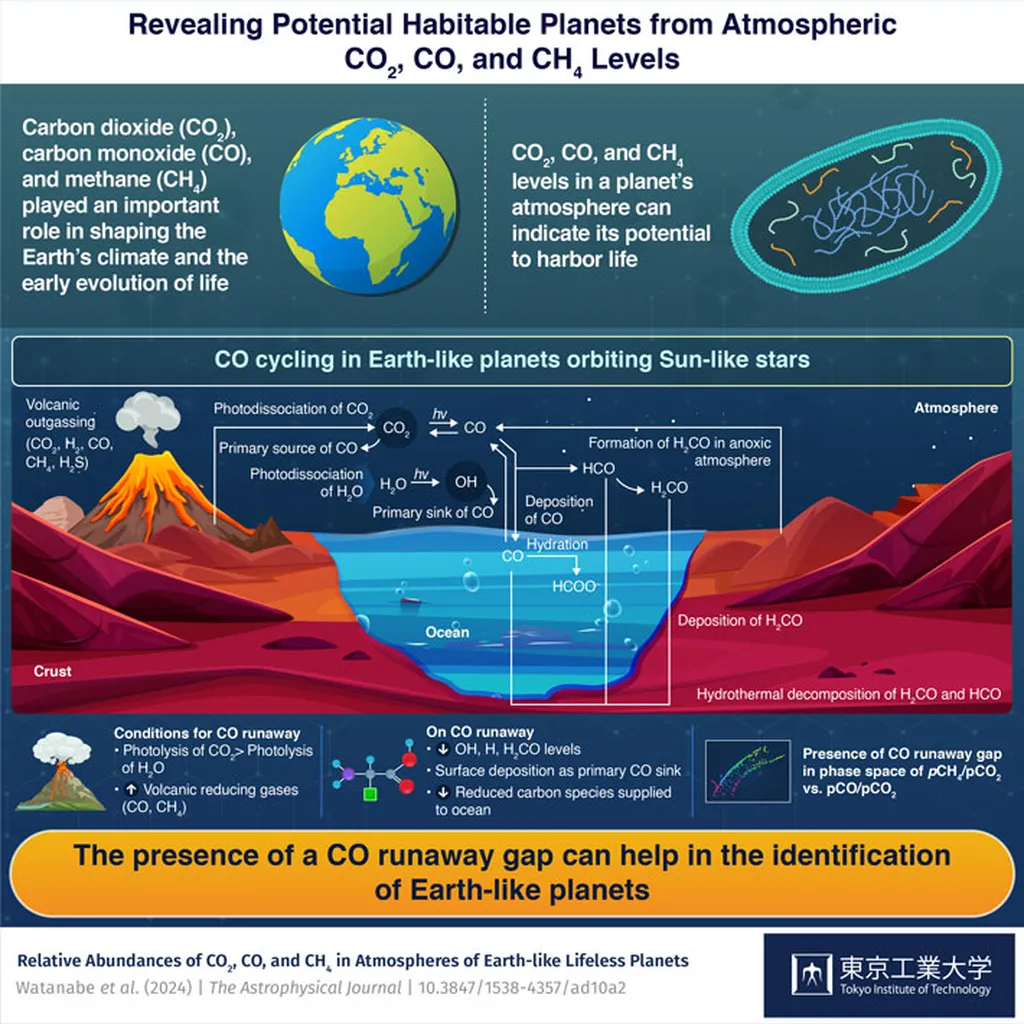
Researchers Yoshiaki Endo, Yasuto Watanabe, and Kazumi Ozaki from the Earth-Life Science Institute at the Tokyo Institute of Technology have published a study in the journal Nature Astronomy that explores how the abundances of atmospheric carbon species—carbon dioxide (CO2), carbon monoxide (CO), and methane (CH4)—are regulated on habitable terrestrial planets across a wide range of stellar and planetary conditions.
The study focuses on understanding the atmospheric compositions of lifeless, Earth-like planets orbiting Sun-like stars, specifically F-, G-, and K-type stars. The researchers developed an integrated numerical model that couples atmospheric chemistry, climate, and the long-term carbon cycle. This model allows them to investigate how different stellar types and orbital distances influence the atmospheric carbon chemistry of these planets.
The simulations demonstrate that CO2, CO, and CH4 generally increase with orbital distance. Planets near the outer edge of the habitable zone may experience a phenomenon called CO runaway, a photochemical instability driven by severe depletion of hydroxyl (OH) radicals. The threshold for CO runaway depends strongly on the spectral type of the star and is most easily triggered around cooler, lower-mass stars.
In contrast, the atmospheric production of formaldehyde (H2CO), a key precursor for prebiotic organic chemistry, peaks around planets orbiting more massive, UV-luminous stars. The production of H2CO is maximized at orbital distances just interior to the CO-runaway threshold. This finding establishes a quantitative framework linking observable system properties—stellar type and orbital distance—and the atmospheric carbon chemistry of lifeless Earth-like planets.
The results provide new context for interpreting future spectroscopic observations and for evaluating the potential of such planets to sustain prebiotic chemistry. This research is crucial for understanding the conditions necessary for the emergence of life on other planets and could guide future missions aimed at detecting signs of life beyond Earth.
The study was published in the journal Nature Astronomy, offering a significant contribution to the field of exoplanet research and astrobiology.
This article is based on research available at arXiv.