
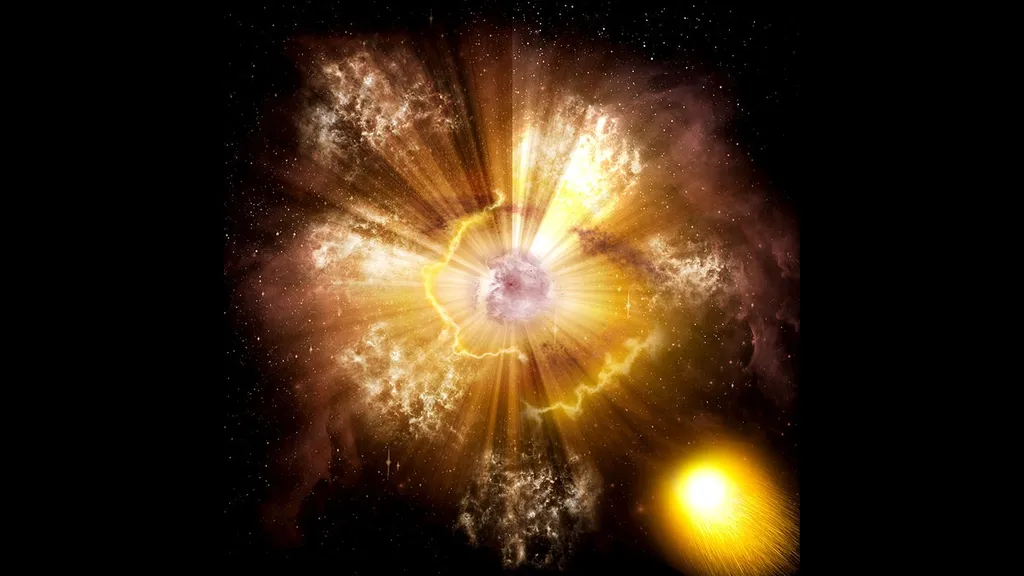
Researchers from the University of Sydney and the University of Milan have published a study in the Astrophysical Journal that sheds light on the dynamics of galactic winds driven by supernovae near the center of the Milky Way. The team, led by Andrea Afruni and Enrico M. Di Teodoro, has developed models to understand how these powerful outflows interact with and accelerate cold gas clouds.
The study focuses on the complex interplay between different phases of gas in the Milky Way’s central region. Observations have revealed high-velocity gas in various states, from extremely hot to relatively cool, all moving rapidly away from the galactic center. To make sense of these observations, the researchers created semi-analytical models that simulate the behavior of a multiphase outflow. This outflow consists of a hot gas phase, with temperatures far exceeding a million degrees, which carries along colder clouds of gas with temperatures around 5,000 degrees Kelvin.
The models incorporate several key physical processes, including the gravitational pull of the Milky Way, the drag force exerted by the hot gas on the cold clouds, and the exchange of mass, momentum, and energy between the different gas phases. By comparing their model predictions with actual observations of high-velocity hydrogen clouds (HI clouds) near the galactic center, the researchers found that supernova-driven winds, fueled by star formation in the central molecular zone, can explain the observed velocities, spatial distribution, and masses of these clouds.
One of the significant findings of the study is that the cold clouds are accelerated by the hot wind through ram pressure drag and the accretion of high-velocity material. This material results from the turbulent mixing and subsequent cooling of the hot and cold gas phases. However, this interaction also leads to the gradual disruption of the clouds, with smaller clouds losing over 70% of their initial mass by the time they reach approximately 2 kiloparsecs above the galactic plane.
The study’s results have practical implications for understanding galactic feedback mechanisms, which are crucial for regulating star formation and the overall evolution of galaxies. In the context of the energy sector, insights into these processes can inform models of energy transport and dissipation in astrophysical systems, potentially offering analogies for understanding fluid dynamics and heat transfer in industrial applications. Additionally, the research highlights the importance of multiphase flows in astrophysical environments, which can inspire innovative approaches to managing and optimizing energy systems that involve multiple phases or states of matter.
The research was published in the Astrophysical Journal, a leading journal in the field of astrophysics and astronomy.
This article is based on research available at arXiv.