
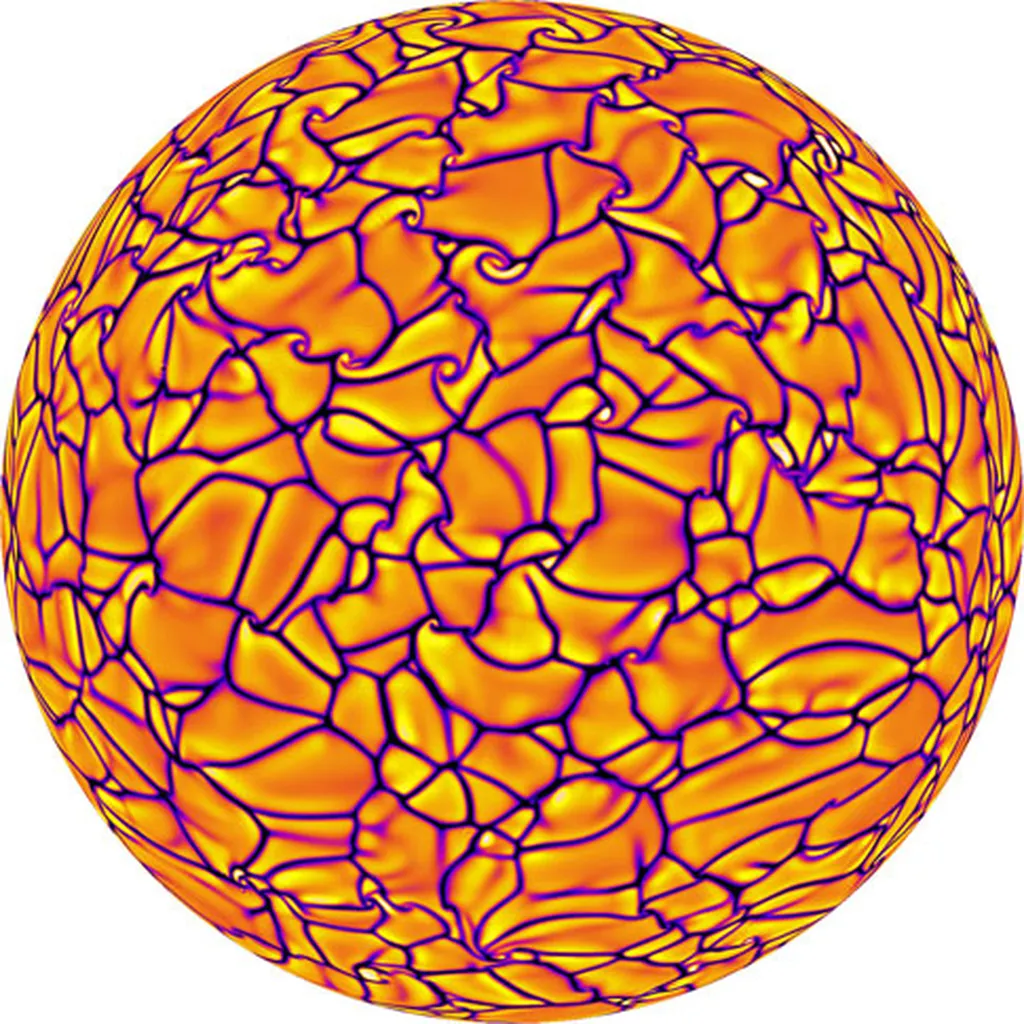
Researchers Oana Vesa, Junwei Chen, and Ruizhu Chen from the National Solar Observatory in Boulder, Colorado, have been studying solar equatorial Rossby waves, which have been identified in the past decade as potential indicators of solar interior dynamics. Their recent findings, published in the journal Astronomy & Astrophysics, shed light on the behavior of these waves at different depths within the Sun and their correlation with the solar cycle.
The team analyzed approximately 14.5 years of data from the Solar Dynamics Observatory’s Helioseismic and Magnetic Imager (SDO/HMI) using two techniques: ring-diagram (RD) and time-distance (TD) helioseismology. They focused on the radial vorticity of the Sun, which is a measure of the rotational motion within the solar interior. By filtering and processing this data, they were able to compute normalized phase differences and cross power to investigate the structural tilt and power of Rossby waves at various depths.
The researchers found that Rossby waves exhibit a systematic and robust depth-dependent phase behavior. Deeper layers of the Sun lead in phase over shallower ones, with the phase difference becoming more negative with increasing depth. This behavior suggests that Rossby waves tilt retrograde relative to the Sun’s rotation, a tilt that remains stable throughout the solar cycle. Interestingly, this tilt is not unique to the Sun; similar small tilts have been observed in planetary atmospheres and in magnetohydrodynamic simulations of the Sun, indicating that it is a common feature in rotating, stratified bodies.
The depth-dependent cross power of Rossby waves, which measures their amplitude, was found to exhibit a positive correlation with the solar cycle. This means that the power of these waves increases and decreases in tandem with the Sun’s 11-year activity cycle. However, the phase behavior did not show a clear significant correlation with the solar cycle.
The practical applications of this research for the energy sector, particularly the solar energy industry, are not immediately apparent. However, a better understanding of solar interior dynamics and the behavior of Rossby waves could potentially improve our ability to predict solar activity, which in turn could enhance the forecasting of space weather events. These events can impact satellite operations, power grids, and other technologies, making accurate predictions invaluable for maintaining the reliability and efficiency of energy infrastructure. Moreover, a deeper understanding of the Sun’s behavior could also contribute to advancements in solar energy technologies, such as improved solar forecasting for solar power plants.
This article is based on research available at arXiv.