
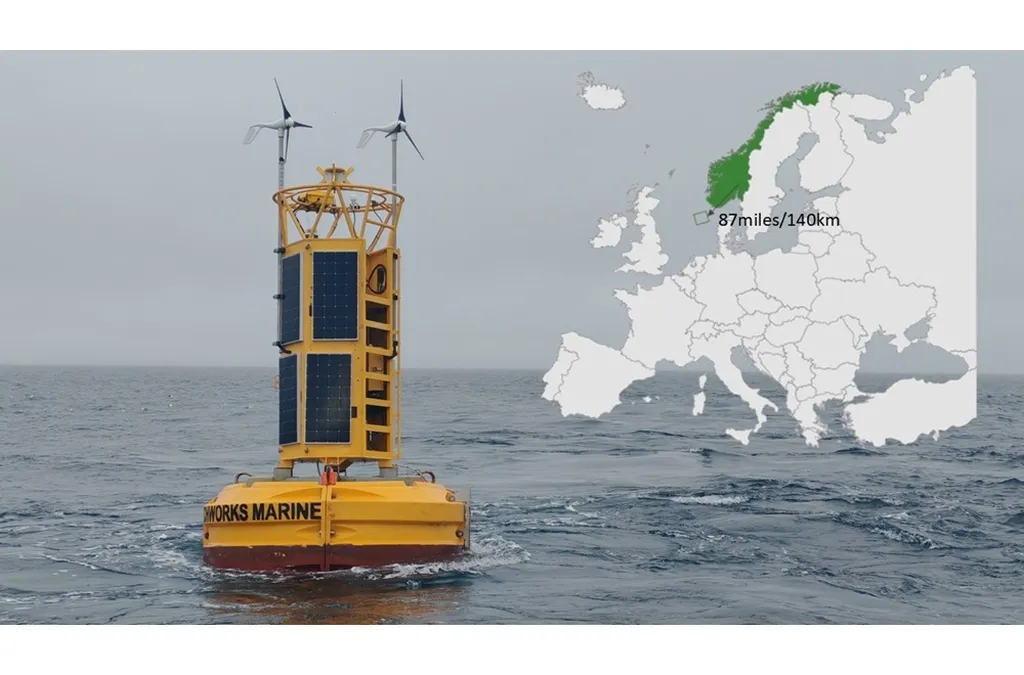
In the realm of oceanographic instrumentation, a team of researchers from the University of Tromsø – The Arctic University of Norway has developed an innovative, open-source solution for coastal water measurements. The team, led by Lars Willas Dreyer, includes Andrea Pferscher, Riccardo Sieve, Jean Rabault, Atle Jensen, Einar Broch Johnsen, and Gaute Hope, who collectively aim to advance the accessibility and affordability of oceanographic technology.
The researchers have introduced the Open Lora Buoy (OLB), a low-cost, modifiable, and power-efficient drifter buoy that utilizes Long-range radio (LoRa) technology for data transmission. LoRa is particularly advantageous for its low data transfer cost and power consumption, and it does not require pre-existing infrastructure, making it ideal for remote and coastal areas. The OLB is designed to be reliable and functional, competing with commercial and closed-source buoys in terms of performance and availability.
In their validation experiments, the researchers demonstrated that the OLB can achieve a radio telemetry range of over 2 kilometers. Additionally, the buoy has an expected battery lifetime of up to seven months, which is a significant improvement over many existing solutions. The OLB’s open-source nature allows for easy modification and customization, making it a versatile tool for various oceanographic applications.
The practical applications of the OLB in the energy sector are promising. For instance, offshore wind farms and other coastal energy projects require continuous monitoring of ocean conditions to ensure safety and efficiency. The OLB can provide real-time data on water temperature, salinity, and currents, which are crucial for optimizing energy production and maintenance schedules. Furthermore, the low cost and ease of deployment make the OLB an attractive option for small-scale energy projects and research initiatives.
The research was published in the journal Sensors, highlighting the potential of open-source technology in revolutionizing oceanographic instrumentation and contributing to more sustainable and efficient energy practices. As the energy sector continues to explore and utilize coastal and offshore resources, the OLB offers a valuable tool for monitoring and understanding the dynamic ocean environment.
This article is based on research available at arXiv.