
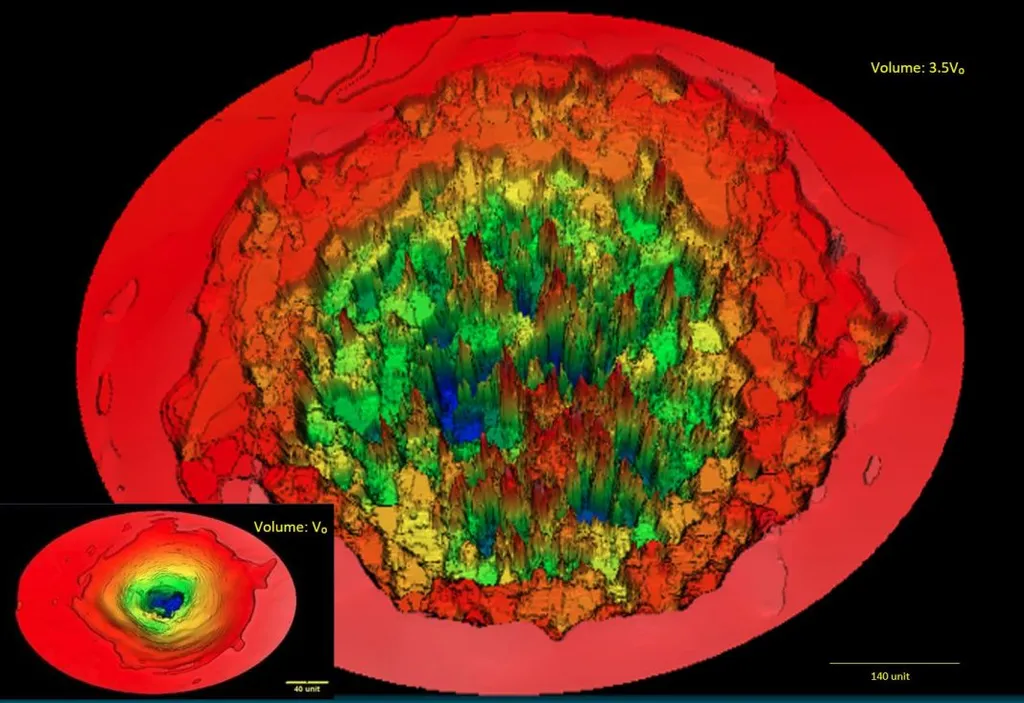
Researchers from the FUSENOW and NAPLIFE collaborations, led by experts such as Zsuzsanna Márton and Aldo Bonasera, have published a study in the journal Physical Review Letters that explores a novel approach to laser-induced fusion. Their work aims to address some of the challenges faced by current fusion methods, offering a potential path towards more efficient and stable fusion reactions.
Current laser fusion techniques rely on extreme mechanical compression to create a hotspot, initiating ignition. However, this process is slow, and the subsequent fusion burning can spread more slowly than the expansion of the target, leading to mechanical instabilities. The researchers propose a different approach using nano-antennas to achieve simultaneous ignition throughout the entire target volume. This method leverages protons accelerated in the direction of the nano-antennas, which are oriented orthogonal to the laser irradiation.
The use of nano-antennas allows for a radiation-dominated system, where ignition occurs rapidly and uniformly. This contrasts with current methods that use an ablator surface to increase compression and prevent laser energy penetration, an approach based on an assumption that the researchers argue is flawed. By avoiding this assumption, the team opens up the possibility of faster, more controlled fusion reactions.
For the energy sector, this research could have significant implications. More efficient and stable fusion reactions could pave the way for practical fusion power plants, offering a clean and virtually limitless energy source. The use of nano-antennas could also reduce the need for extreme mechanical compression, potentially simplifying the design and operation of fusion reactors. While further research and development are needed to translate this approach into practical applications, the findings represent a promising step forward in the quest for sustainable fusion energy.
The research was published in Physical Review Letters, a prestigious journal known for its high-impact studies in the field of physics.
This article is based on research available at arXiv.