
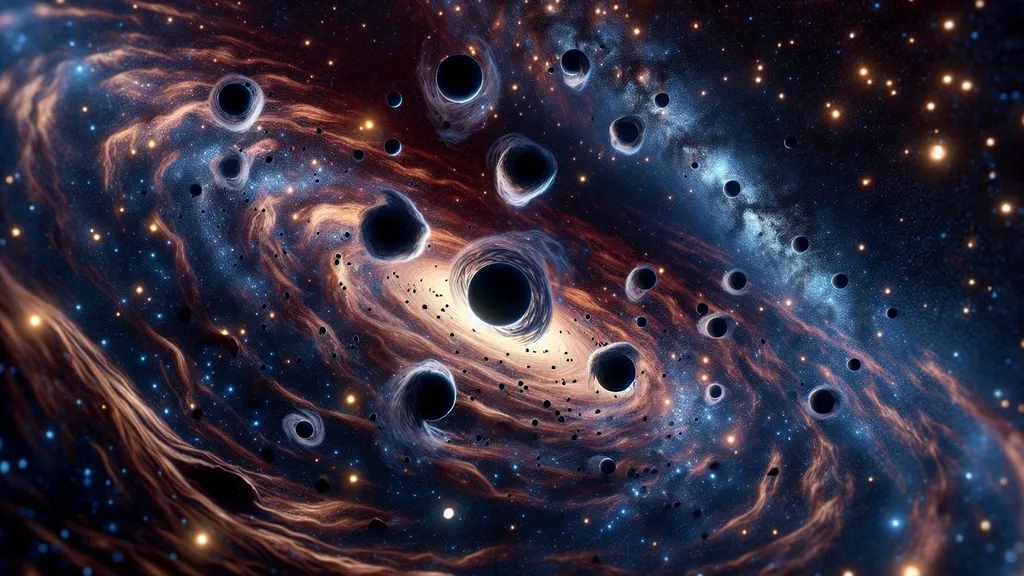
In the realm of energy and astrophysics, researchers Alexandra P. Klipfel and David I. Kaiser from the Massachusetts Institute of Technology (MIT) have been exploring the intriguing possibilities of primordial black holes (PBHs) and their potential interactions with matter. Their recent study, published in the journal Physical Review D, delves into the concept of gravitational ionization by Schwarzschild PBHs and its implications for dark matter detection and energy deposition in the early universe.
Primordial black holes are theorized to have formed from the collapse of overdensities in the very early universe. These black holes, particularly those in the asteroid-mass range, are challenging to detect due to their modest rates of Hawking emission and sub-micron Schwarzschild radii. Klipfel and Kaiser’s research considers whether the steep gravitational field gradients of a PBH could generate tidal forces strong enough to disrupt atoms and nuclei, potentially yielding new observables that could distinguish a PBH from a macroscopic object of the same mass.
The researchers first examined the gravitational ionization of ambient neutral hydrogen and evaluated the prospects for detecting photon radiation from the recombination of ionized atoms. They found that, during the present epoch, this effect would be overshadowed by Hawking radiation, which itself would be difficult to detect for PBHs at the upper end of the asteroid-mass window.
Next, the study considered the gravitational ionization and heating of neutral hydrogen immediately following recombination at a redshift of approximately 1090. The researchers identified a broad class of PBH distributions with typical masses ranging from 5×10^21 grams to 10^23 grams, within which gravitational interactions would have been the dominant form of energy deposition to the medium.
Furthermore, the study explored conditions under which tidal forces from a transiting PBH could overcome the strong nuclear force. This could lead to the dissociation of deuterons, relevant during big bang nucleosynthesis (BBN), or the induction of fission of heavy nuclei. The researchers found that gravitational dissociation of deuterons dominates photodissociation rates due to Hawking radiation for PBHs with masses between 10^14 grams and 10^16 grams. They also identified the phenomenon of gravitationally induced fission of heavy nuclei via tidal deformation.
While the practical applications for the energy sector may not be immediately apparent, understanding the behavior of primordial black holes and their interactions with matter could have profound implications for our comprehension of dark matter and the early universe. This knowledge could potentially inform future energy technologies and strategies, particularly those involving advanced propulsion systems or exotic energy sources. As research in this area continues, the energy industry may find new avenues for innovation and development inspired by these fundamental discoveries.
Source: Physical Review D
This article is based on research available at arXiv.