
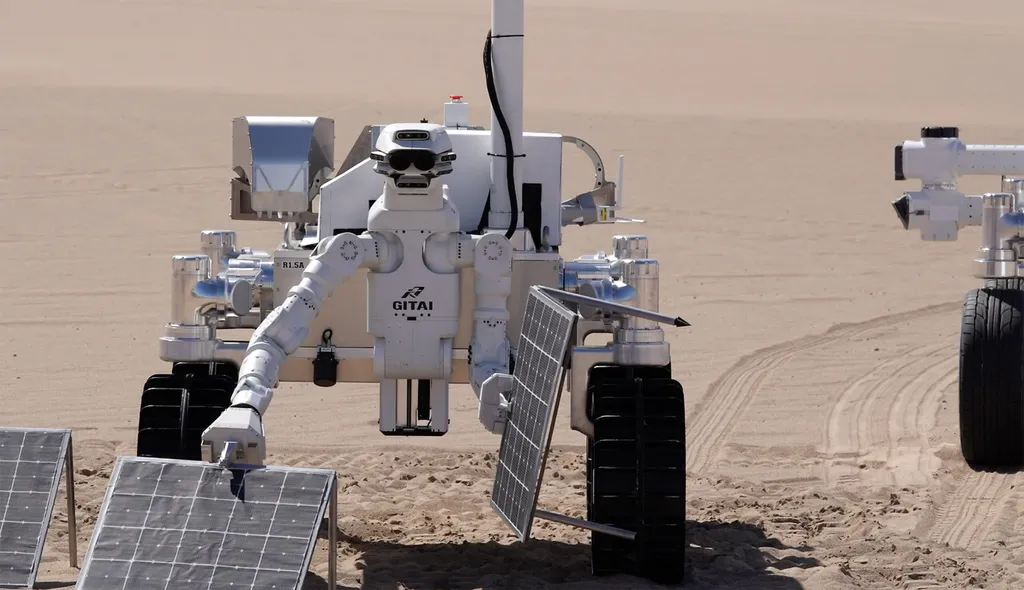
Researchers from the University of Rome, Sapienza, and the Tohoku University in Japan have collaborated on a study aimed at advancing the capabilities of robotic systems for lunar base construction. The team, led by Luca Nunziante and Alessandro De Luca from the University of Rome, Sapienza, and Kazuya Yoshida from Tohoku University, has developed an autonomous system for assembling solar panels using dual robot arms. Their work was published in the journal “Frontiers in Robotics and AI.”
The researchers are focusing on the practical scenario of shipping necessary components to the Moon and assembling them in situ, similar to the construction of the International Space Station (ISS). Their study explores the integration of vision, control, and hardware systems within an autonomous sequence for a dual-arm robot system. The goal is to establish essential infrastructure, such as solar power generating towers, which are crucial for a lunar outpost.
The team designed and tested ad hoc hardware in real-world experiments. They used a mock-up of modular solar panels and active-passive connectors, with the control of the grappling fixture integrated into the proposed pipeline. The successful implementation of their method demonstrates that the two robot manipulators can effectively connect arbitrarily placed panels. This highlights the seamless integration of vision, control, and hardware systems in complex space applications.
For the energy sector, this research has significant implications. The ability to autonomously assemble solar panels on the Moon could pave the way for similar technologies to be used on Earth. In remote or hazardous locations, such as deserts or offshore environments, dual-arm robot systems could be deployed to construct solar farms with minimal human intervention. This could reduce costs, improve safety, and increase the efficiency of solar energy deployment.
Furthermore, the integration of vision, control, and hardware systems demonstrated in this study could be applied to other energy infrastructure projects. For example, robotic systems could be used to assemble wind turbines, maintain power lines, or even construct nuclear reactors. The potential for autonomous robotics in the energy sector is vast, and this research represents a significant step forward in that direction.
This article is based on research available at arXiv.