
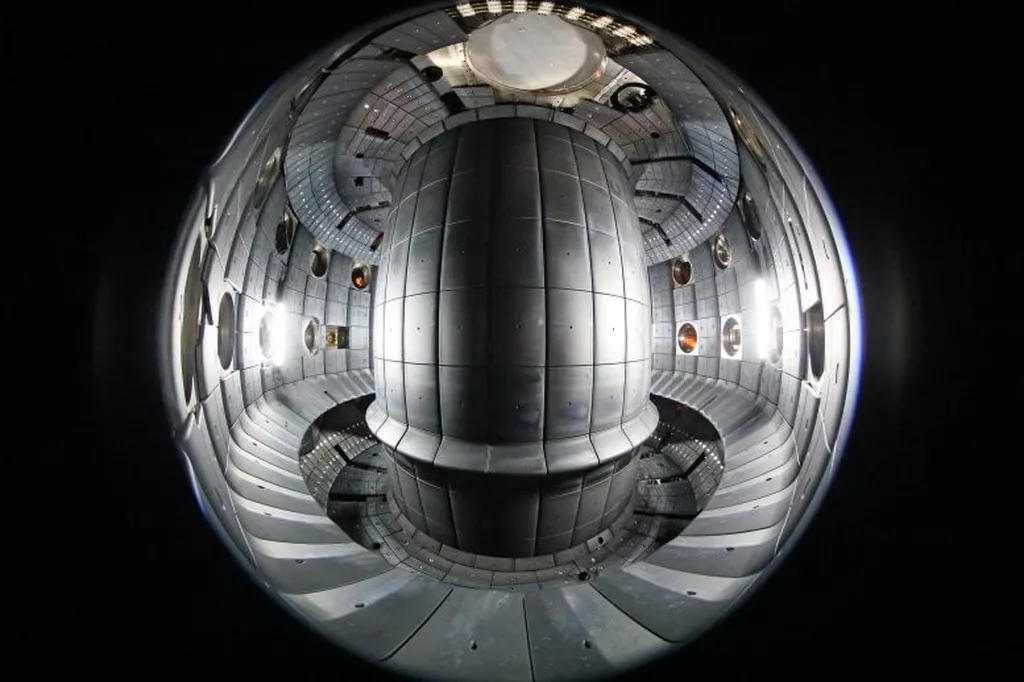
Researchers from the Swiss Plasma Center at École Polytechnique Fédérale de Lausanne (EPFL), including Brenno De Lucca, Paolo Ricci, Micol Bassanini, Sergio García Herreros, and Zeno Tecchiolli, have made a significant advancement in plasma physics that could have implications for the energy sector, particularly in fusion energy research. Their work, titled “Conservative formulation of the drift-reduced fluid plasma model,” was recently published in the Journal of Plasma Physics.
Plasma, the fourth state of matter, is a key area of study for fusion energy, as it is the medium in which fusion reactions occur. The researchers have developed a new model that accurately describes the behavior of plasma in magnetic fields, which is crucial for understanding and improving fusion reactors. The model is unique because it satisfies exact conservation laws for energy, mass, charge, and momentum, even when electromagnetic fluctuations are included. This is a significant improvement over previous models, as it provides a more accurate and comprehensive description of plasma behavior.
The new model is also notable because it can be applied to arbitrary magnetic geometries. This means that it can be used to study plasma behavior in a wide range of fusion reactor designs, making it a valuable tool for the energy industry. The researchers achieved this by analytically inverting the implicit relation defining the polarization velocity as a function of the time-derivative of the electric field. This technical advancement allows for a more precise and efficient modeling of plasma dynamics.
The practical applications of this research for the energy sector are significant. A better understanding of plasma behavior can lead to improved fusion reactor designs, which could make fusion energy a more viable and sustainable energy source. Fusion energy has the potential to provide a nearly limitless source of clean energy, and advancements in plasma physics are crucial for realizing this potential. The new model developed by the researchers at EPFL is a step forward in this direction.
In summary, the researchers have developed a new plasma model that provides a more accurate and comprehensive description of plasma behavior in magnetic fields. This model could have significant implications for the energy industry, particularly in the field of fusion energy. The research was published in the Journal of Plasma Physics.
This article is based on research available at arXiv.