
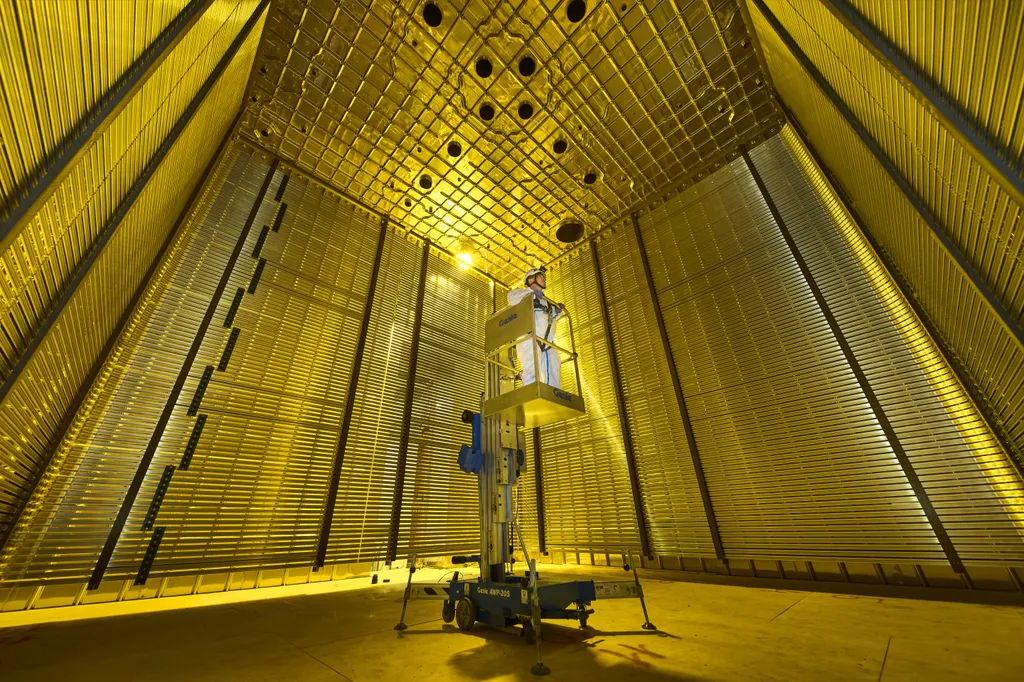
In the realm of energy and particle physics, a significant stride has been made by the Deep Underground Neutrino Experiment (DUNE) collaboration, led by researchers from various institutions, including the University of Michigan, Fermilab, and many others. Their recent study focuses on the reconstruction of atmospheric neutrinos within DUNE’s far detector module, a liquid argon time projection chamber (LArTPC) with horizontal drift. This research is crucial for advancing our understanding of neutrino interactions, which has implications for both fundamental physics and energy applications.
The DUNE collaboration, comprising a diverse and extensive team of scientists, has developed sophisticated methods to reconstruct and identify atmospheric neutrino interactions. Their work is based on a workflow initially designed for DUNE’s long-baseline oscillation analysis. To adapt this workflow for atmospheric neutrinos, the researchers retrained some machine-learning models and added features specific to atmospheric neutrinos, such as neutrino direction reconstruction. This comprehensive approach enhances the accuracy of neutrino detection and analysis.
The study highlights the importance of incorporating more than just lepton information in the reconstruction process. By considering all particles identified in the LArTPC, the researchers achieved significant improvements in both neutrino direction and energy reconstruction. Three neutrino direction reconstruction methods were developed and studied: using lepton-only information, using all reconstructed particles, and using only correlations from reconstructed hits. The results indicate that incorporating all available particle information leads to better resolution and more accurate neutrino flavor identification.
The practical applications of this research extend to the energy sector, particularly in the development of advanced neutrino detection technologies. Accurate reconstruction of neutrino interactions is essential for monitoring and understanding neutrino fluxes, which can be influenced by various energy production processes. This knowledge can contribute to the development of safer and more efficient nuclear reactors and other energy technologies that involve neutrino interactions.
Moreover, the study’s findings can enhance our ability to detect and analyze neutrinos produced by natural sources, such as the Sun and atmospheric interactions. This capability is crucial for monitoring environmental changes and understanding the fundamental processes driving our universe. The DUNE collaboration’s work represents a significant step forward in neutrino physics, with potential benefits for both scientific research and practical energy applications.
The research was published in the Journal of Instrumentation, a reputable source for cutting-edge developments in particle physics and related fields. This study underscores the importance of interdisciplinary collaboration and the continuous advancement of detection technologies in the pursuit of scientific knowledge and energy innovation.
This article is based on research available at arXiv.