
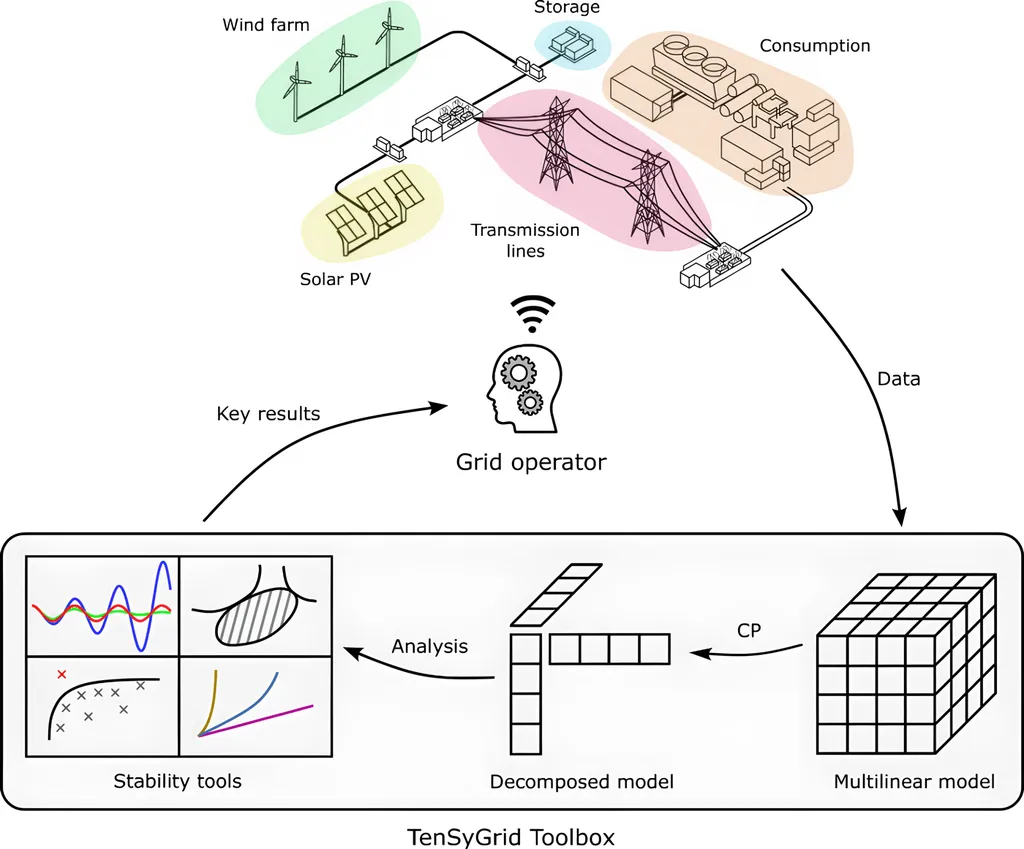
Researchers from the Barcelona Supercomputing Center and other institutions have developed a new tool to enhance the stability and performance of modern power systems. Luis A. Garcia-Reyes, Oriol Gomis-Bellmunt, Eduardo Prieto-Araujo, Vinícius A. Lacerda, and Marc Cheah-Mañe have created SIaD-Tool, an open-source software designed to assess and improve the stability of contemporary power grids. Their work was recently published in the IEEE Transactions on Power Systems.
SIaD-Tool is a frequency-domain scanning solution that helps identify and analyze potential stability issues in power systems. It supports various frames of reference, including abc, dq0, and 0pn, and employs both series voltage and parallel current perturbation strategies. One of its key features is a novel perturbation scheme that allows direct scanning in the target frame, making it easier to analyze coupling effects and mirrored frequencies.
The tool is implemented on a multi-platform architecture, compatible with MATLAB/Simulink and Python-PSCAD/EMTDC. This versatility ensures that it can be integrated into existing workflows and used by a wide range of professionals in the energy sector. SIaD-Tool not only identifies potential stability issues but also provides automated stability evaluation through four standardized methods: Generalized Nyquist Criterion (GNC), modal impedance analysis, phase margin assessment, and passivity checks.
The researchers validated SIaD-Tool through extensive case studies involving passive elements, grid-following and grid-forming converters, offshore wind power plants, and the IEEE 9-bus system. The results demonstrated high accuracy, scalability, and robustness in detecting critical modes, interaction frequencies, oscillatory behavior, and stability margins. This makes SIaD-Tool a valuable asset for engineers and researchers working to enhance the stability and reliability of modern power systems.
For the energy industry, SIaD-Tool offers practical applications in the design, operation, and maintenance of power grids. By identifying potential stability issues before they become critical, the tool can help prevent blackouts and other disruptions, ensuring a more reliable and efficient power supply. Additionally, its ability to analyze the interaction between different components of the grid can aid in the integration of renewable energy sources, a key challenge for the energy sector as it transitions to cleaner, more sustainable sources of power.
This article is based on research available at arXiv.